The Language That Never Stopped Growing: Making of Modern English
How invasions, empires, and inventions layered thousands of years of history into the vocabulary you use today.
- Introduction: A Living Museum of Language
- Chapter 1: Before English Existed
- Chapter 2: The Germanic Foundation
- Chapter 3: The Language of Invaders
- Chapter 4: Why English Has Three Words for Everything
- Chapter 5: When English Lost Its Rules (And Became More Powerful)
- Chapter 6: The Printing Press Froze Time
- Chapter 7: The World's Greatest Collector of Words
- Chapter 8: The Explosion of Knowledge
- Chapter 9: From Empire to the Internet
- Chapter 10: Why English Keeps Changing
- Key Takeaways
- Conclusion
- Frequently Asked Questions
- Why English has three or more words for nearly everything, and where each tier comes from
- How Viking settlers casually rewrote English's core pronouns
- Why English spelling looks broken (the printing press froze it mid-shift)
- How English became the world's most aggressive borrower of foreign words
Introduction: A Living Museum of Language
Modern English contains words left behind by Viking raiders, coined by Roman priests, mandated by French kings, traded by Indian merchants, and calculated by Arab mathematicians. It features vocabulary forged in Hollywood, coded in Silicon Valley, and synthesized by artificial intelligence.
How did one obscure island dialect become the largest, most diverse linguistic repository in human history?
The answer reveals a universal truth about how languages evolve. English is not a carefully designed system. It was not engineered by a central academy, nor did it evolve in peaceful isolation. Instead, it is the product of traumatic invasions, mass migrations, vast imperial expansion, and relentless technological revolutions. Every historical accident, geopolitical shift, and cultural collision left a permanent layer of sediment inside the language.
To understand English is to realize that it is less like a manufactured tool and more like a living museum of human civilization. It is an ever-expanding archive where every borrowed word is another exhibit, every irregular spelling preserves a fossilized pronunciation, and every synonym represents a distinct historical layer.
Here is the story of why English looks and sounds the way it does today.

Chapter 1: Before English Existed
If you trace the ancestry of humanity's languages far enough back, you do not find a neat grid of distinct tongues, but rather a tangled, sprawling family tree.
The story of English begins roughly six thousand years ago with an unwritten ancestral tongue known as Proto-Indo-European (PIE). Spoken by nomadic pastoralists likely originating in the Pontic-Caspian steppe, PIE is the common ancestor of most European and South Asian languages.
Because the language predates writing, historical linguists must reconstruct it by looking for artifacts hidden in its modern descendants. Languages rarely share vocabulary by accident. Because tongues across Europe and India share related root words (known as cognates) for concepts like "horse," "axle," and "wheel," linguists deduce that the original speakers of PIE lived together at least until the invention of wheeled transport. Their shared technology dictated their shared vocabulary.
PIE was structurally complex, relying on highly inflected word endings and a musical, free-floating pitch accent where stress could fall on any syllable. Though that musical grammar has long since vanished from English shores, this ancient steppe language still forms the deep bedrock of the modern lexicon, supplying our most primal vocabulary for familial relations, basic numbers, and the natural world.
These words are the oldest artifacts in the museum's basement. But how did this single ancestral tongue fracture into the highly varied languages we recognize today?
Chapter 2: The Germanic Foundation
Why does a German speaker sound so fundamentally different from an Italian speaker, even if their languages share the same ancient ancestor? The answer lies in isolation, environment, and a mysterious, systemic shift in human speech.
As populations migrated north from the steppes, a distinct linguistic branch emerged: Proto-Germanic. These Iron Age agriculturalists lived in a decentralized, tribal society, and their vocabulary naturally reflected a rugged existence tied to farming, warfare, and seafaring.
During this era, a sweeping phonetic transformation permanently fractured the language family. Known today as Grimm's Law, this shift saw voiceless stops transform systematically into voiceless fricatives. If you have ever wondered why the ancient PIE root for "father" (starting with a p sound) became pater in Latin but shifted to an f sound in Germanic languages, you are witnessing Grimm's Law in action.
Simultaneously, a phonetic rule called Verner's Law dictated that certain consonants became voiced depending on where the original, ancient PIE pitch accent fell. Eventually, Proto-Germanic lost that musical pitch accent entirely, permanently locking the stress onto the first syllable of the root word.
Languages change when populations move. When the Roman Empire withdrew from Britain in the fifth century, Germanic tribes (the Angles, Saxons, and Jutes) sailed across the North Sea, pushing the native Celtic-speaking Britons to the geographic fringes. The language they brought, Old English, was fiercely Germanic and highly synthetic. It relied on grammatical gender, case declensions, and complex word endings to convey meaning, rather than the strict word order we use today.
It is easy to forget just how small and insular the English language once was. While it absorbed a trickle of Latin words through Christianization in the seventh century, the Old English lexicon remained intensely pure; less than three percent of its vocabulary consisted of loanwords.
Nearly 90 percent of this original Old English vocabulary has since died out. Yet, the surviving 10 percent (words like earth, house, food, sleep, is, you) provides the indispensable function words of everyday speech.
English began as a closed ecosystem. But what happens when a small, pure language is violently cracked open by the outside world?
Chapter 3: The Language of Invaders
Imagine an English where the sky was not called the sky, a window was not a window, and anger was not anger. Without the trauma of invasion, our dictionary would be unrecognizably thin.
Languages rarely become richer in isolation; they evolve through contact. Beginning in the late eighth century, Norsemen raided and settled vast swathes of England, creating a political zone called the Danelaw. Because Old English and Old Norse were linguistic cousins, they were mutually intelligible to a degree. This allowed for a deep, localized cultural assimilation.
The Vikings did not just leave behind words for war; they gifted English with fundamental, everyday terms. Egg, knife, ill, and flat are all Viking imports. Most astonishingly, they contributed core pronouns like they, them, and their. It is incredibly rare for a language to replace its foundational pronouns, yet English did exactly that, prioritizing practicality over purity.
But the most catastrophic linguistic reset occurred in 1066.
William the Conqueror's victory at the Battle of Hastings eradicated the English aristocracy, imposing a French-speaking ruling class for the next three centuries. Latin became the language of the church, French the language of the court, and English was subjugated as the tongue of the peasantry.
This power dynamic created a massive influx of roughly ten thousand French words, dominating semantic fields of governance, military, and art. It also built a permanent exhibit dedicated to class division within our vocabulary.
The Anglo-Saxon peasants raised the animals: cow, pig, sheep. Naturally, they used their native words for the creatures they tended every day. The French nobles, however, only interacted with those animals when they were served at the dining table, and so they used their own words for the meat: beef, pork, mutton.
History leaves layers. English didn't become powerful despite being conquered. It became powerful because of it.
Every invasion strengthened the language, forcing it to accumulate rather than replace. However, this relentless layering created a unique problem: English suddenly had too many words for the exact same thing.
Chapter 4: Why English Has Three Words for Everything
Have you ever noticed that in English, you can ask a question, question a methodology, or interrogate a suspect?
This is not a coincidence. It is the architectural blueprint of the language. Because English absorbed foreign vocabulary rather than replacing native words, it developed parallel vocabularies. This historical layering created an immense inventory of synonyms, allowing speakers unparalleled precision in emotional register and tone. Every synonym preserves a different civilization.
This stratification generally operates across three distinct tiers. The foundational tier is Germanic. These are the oldest, most visceral words in the language. The second tier is French, carrying associations of formality, administration, and literature. The third tier is Latinate, introduced later by scholars to provide precision, abstract thought, and clinical detachment.
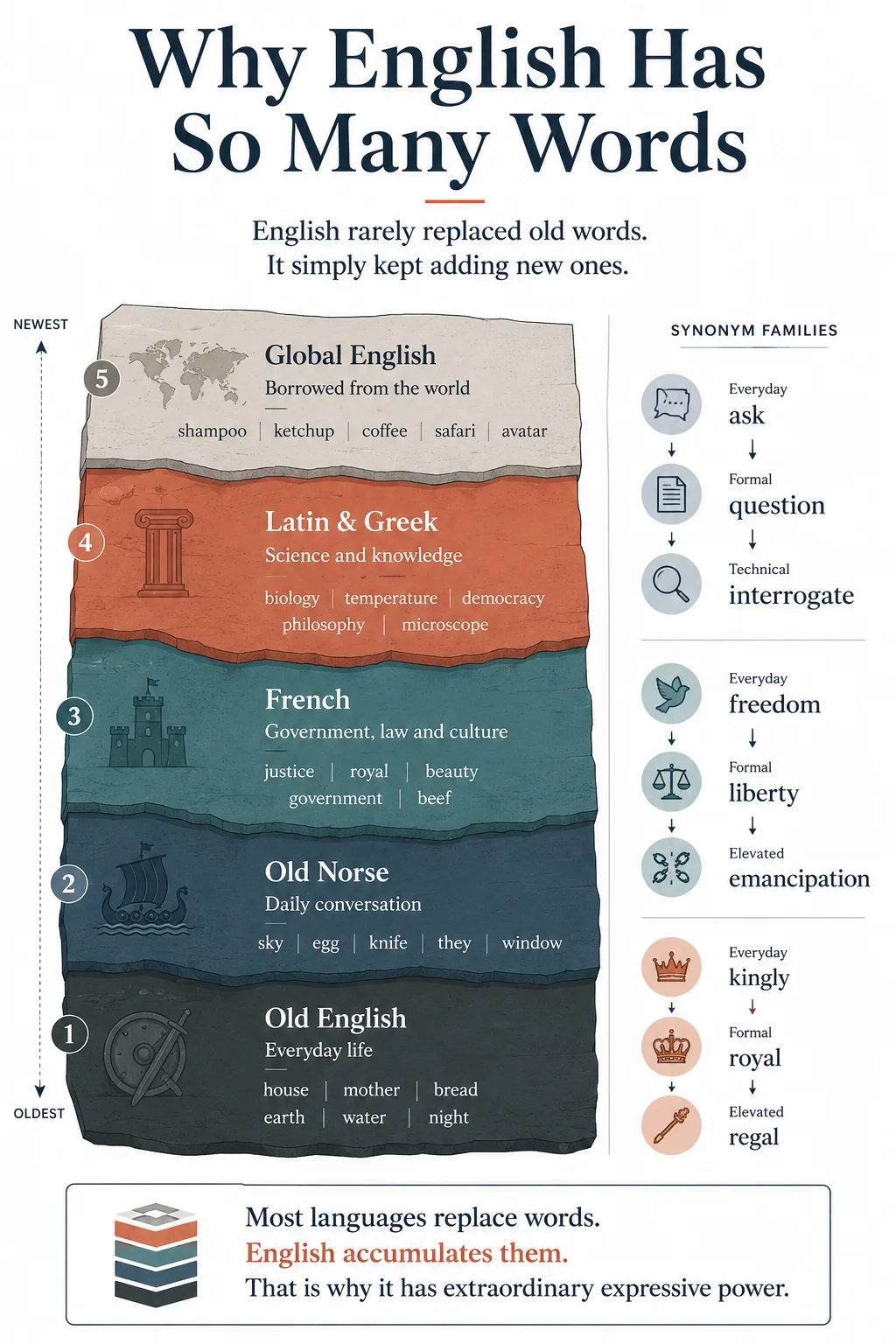
Consider a ruler. They can be described with the emotional, Germanic word kingly. They can represent the institution with the French word royal. Or they can project majestic authority with the Latin word regal.
A citizen might secure their freedom (Germanic), demand their liberty (French), or await their emancipation (Latin). This tri-level synonymy is English's greatest superpower, transforming it into an instrument capable of expressing the most subtle gradations of human thought.
English never had to choose between old words and new ones. It kept both, and let tone do the sorting: Germanic for the everyday and emotional, French for the formal and institutional, Latin for the precise and abstract.
But housing all these thousands of new words would have been structurally impossible if the grammar had remained rigid. Fortunately, the grammar was quietly collapsing.
Chapter 5: When English Lost Its Rules (And Became More Powerful)
If English is such a massive, complicated language, why do novice learners sometimes assume it has no grammar?
The answer lies in the ashes of the Norman Conquest. Stripped of prestige and relegated to the uneducated working classes, spoken English began to rapidly decay structurally. Because Germanic speech placed heavy stress on the first syllable of a word, the complicated, unstressed inflectional endings at the ends of words were slowly swallowed and eroded in everyday conversation.
By the time Middle English stabilized, the language had lost its complex suffixes, grammatical genders, and cases. To compensate for the missing grammar, English developed an incredibly strict, rigid subject-verb-object word order. English abandoned morphological grammar in favor of strict syntax.
This structural collapse was the greatest thing to ever happen to the English vocabulary. Without complex inflectional rules dictating word endings, English became a frictionless linguistic sponge. It developed a mechanic called "functional shift" or "zero derivation". In modern English, because words do not have specific endings identifying them as nouns or verbs, they can jump between grammatical categories without changing their form.
A noun like bottle can instantly become a verb (to bottle). This structural hospitality is why a modern brand name like Google can instantly become an action (to google), and why we can email a colleague or impact a decision.
By losing its rules, English unlocked infinite flexibility. Simplicity in grammar enabled unimaginable complexity in vocabulary. But just as the spoken language became wonderfully fluid, a new technology arrived to freeze it in place.
Chapter 6: The Printing Press Froze Time
Imagine writing a word exactly as it sounded, only for your descendants, five hundred years later, to pronounce it completely differently but be forced to use your exact spelling. This is the nightmare of modern English orthography. Spelling is frozen history.
In 1476, a merchant named William Caxton brought the printing press to Westminster. Before this, spelling varied wildly by region. Caxton himself lamented this chaos. He documented a true story of a northern merchant named Sheffield whose ship was becalmed in Kent. Sheffield went ashore and asked a local woman for some egges (the Old Norse word). The woman, confused, said she didn't speak French. Sheffield was enraged, until a bystander intervened and translated the request to eyren, the traditional southern Anglo-Saxon word.
"What should a man in these days now write, eggs or eyren?" Caxton despaired.
To ensure commercial viability, printers standardized the language based on the dialect of London. But they did so at the worst possible moment. English was undergoing a massive phonetic chain reaction called the Great Vowel Shift. Over three centuries, the articulation of long vowels moved progressively higher in the mouth. The word time, once pronounced "tee-meh," fractured into a diphthong. House, once "hoose," did the same.
Because the printing press locked in the old, medieval spellings just as the spoken pronunciations were shifting, English was left with a permanent mismatch. When you look at words like knight and gnaw, you are looking at a phonetic museum; they were once pronounced exactly as they are spelled, complete with a hard k and g. Our modern spelling system appears irrational only because it is a fossil, preserving the ghosts of pronunciations that died centuries ago.
With its grammar simplified and its spelling standardized, English was uniquely primed for a new era of global acquisition.
Chapter 7: The World's Greatest Collector of Words
Many languages protect their borders. They establish central academies to police their vocabulary, often deliberately creating native equivalents for foreign concepts to maintain linguistic purity.
English, however, has never met a useful word it didn't want to steal. Because it lacks a central regulatory body, English vocabulary growth has always been organic and descriptive. It is fundamentally a borrower language; it is estimated that up to seventy percent of the modern English lexicon consists of loanwords acquired from over three hundred and fifty languages.
| Source | Example Words | How They Arrived |
|---|---|---|
| Arabic | algebra, alchemy, zero | Mathematics and science, via medieval trade |
| Hokkien and Cantonese Chinese | ketchup, wok, dim sum | Maritime trade with coastal China |
| Hindi | shampoo, jungle, loot | British colonial rule in India |
| African Bantu languages | banjo, safari, zombie | The transatlantic slave trade |
| Algonquian languages | skunk, moose, pecan | Contact with Native American nations |
English acquired mathematical and scientific concepts from Arabic during medieval trade, adopting words like algebra, alchemy, and zero. Because these words were transmitted indirectly via European translators who didn't understand Arabic grammar, many retain the Arabic definite article al- permanently fused to the root. The language preserved the translators' misunderstanding as another permanent exhibit.
As global maritime trade expanded, regional languages left their mark. From Hokkien Chinese, English took ketchup (originally a fermented fish sauce), and from Cantonese, it took wok and dim sum. These specific borrowings prove that it was southern coastal traders who interfaced with English sailors, not standard Mandarin speakers.
Colonialism fueled the acquisition further. From Hindi came shampoo, jungle, and loot. From the transatlantic slave trade, African Bantu languages contributed banjo, safari, and zombie. From Native American Algonquian tongues came skunk, moose, and pecan.
Other languages might view this massive influx of foreign terminology as a corruption. English views it as a competitive advantage. It absorbs these foreign entities in their raw state and immediately puts them to work, seamlessly turning global history into everyday vocabulary.
But it wasn't just physical trade that demanded new words. The invisible world of ideas was expanding just as fast.
Chapter 8: The Explosion of Knowledge
When the Renaissance sparked a cultural awakening in England, scholars realized their language had a problem. English was viewed as a rustic tool, utterly inadequate for expressing complex philosophy or the emerging disciplines of the Scientific Revolution.
To fix this, writers deliberately mined classical Latin and Greek, importing thousands of words. This sparked the "Inkhorn Controversy," where linguistic purists like Thomas Wilson fiercely mocked the use of pretentious, obscure classical borrowings. (The term "inkhorn" insulted writers by comparing them to the bulky horn containers used to hold ink). Yet, thousands of these artificial coinages, such as defunct, reciprocal, and strenuous, survived to become indispensable pillars of the modern lexicon.
The establishment of institutions like the Royal Society demanded taxonomic precision. Scientists turned to Greek and Latin morphology to synthesize new vocabulary. Why? Because these classical languages were "dead," meaning their definitions were permanently fixed and immune to semantic drift. They were the perfect, unchanging modular building blocks for science.
This set a precedent that persists today: from the telescope to modern biology and quantum mechanics, humanity names its most cutting-edge discoveries using the vocabulary of ancient antiquity.
Science engineered words, but empires exported them.
Chapter 9: From Empire to the Internet
In the modern era, English transitioned from a localized European hybrid into a global linguistic hegemon.
The aggressive expansion of the British Empire established English as the administrative and commercial language across North America, India, Africa, and Australasia. Following the American Revolution, figures like lexicographer Noah Webster sought to carve out a distinct national identity. Viewing British English as flawed, Webster deliberately reformed American spelling to culturally isolate the United States, dropping the "u" from colour and replacing "c" with "s" in defence.
In Britain, the attempt to catalog this exploding global language resulted in a monumental, seventy-year endeavor: the Oxford English Dictionary. The project relied on thousands of volunteer readers mailing in paper quotation slips. One of the most prolific contributors was Dr. W.C. Minor, who submitted over ten thousand meticulously researched slips. When the editor, James Murray, finally visited his star contributor, he discovered that Minor was incarcerated in the Broadmoor Criminal Lunatic Asylum, having committed a paranoid murder.
Dictionaries like the Oxford English Dictionary do not dictate how language should be used; they merely document how it is used. Its most prolific volunteer contributor, submitting over ten thousand citation slips by mail, turned out to be writing from inside a criminal asylum.
Following the Second World War, American economic and technological hegemony cemented English as the preeminent global lingua franca. It became the mandated language of aviation and maritime communication. Crucially, the foundational architecture of the digital age, early programming languages and the internet itself, was engineered in English.
English did not achieve this global dominance due to any inherent linguistic superiority or unique expressive beauty. It became the operating system of the modern world entirely through continuous geopolitical, economic, and technological leverage.
And because of the internet, the evolution of this operating system is no longer measured in centuries, but in days.
Chapter 10: Why English Keeps Changing
Linguistic evolution is not just a thing of the past; it is happening right now, at a speed previously thought impossible.
The vocabulary is subjected to continuous semantic pressures that morph the meanings of words over time. Through a process called amelioration, the word nice (which entered English from Latin meaning "ignorant" or "foolish") slowly upgraded over centuries to mean "precise" and eventually "pleasant". Through pejoration, the word silly (originally meaning "blessed" in Old English) slowly decayed to mean "innocent," then "pitiful," and finally "foolish".
| Word | Original Meaning | Modern Meaning | Process |
|---|---|---|---|
| nice | Ignorant, foolish (from Latin) | Precise, then pleasant | Amelioration |
| silly | Blessed, happy (Old English) | Innocent, then foolish | Pejoration |
Historically, these changes took generations. Today, the internet and algorithmic platforms like TikTok bypass physical geography entirely, generating isolated sociolects that bleed into the mainstream vocabulary instantaneously. Lexicographers at the Oxford English Dictionary now process thousands of new words and senses annually to keep up with the relentless churn of digital culture.
Furthermore, the integration of artificial intelligence is creating hyper-accelerated semantic drift. AI is accelerating semantic evolution faster than any previous era in human history. Specialized computer science jargon like hallucination (a model fabricating data) or prompt engineering is rapidly broadening into everyday metaphors used to describe human cognition and societal trends.
English has detached from its geographic origins to become a digital substrate, evolving in real time across billions of users. The museum never closes.
Key Takeaways
- English Layers Rather Than Replaces: Nearly every invasion added a new vocabulary layer instead of erasing the old one, which is why English has so many overlapping synonyms.
- Invasions Rewrote the Basics: Viking settlers replaced even core function words like "they" and "them," something languages almost never do.
- Class Divided the Dinner Table: The Norman Conquest split English into a peasant vocabulary (cow, pig) and an aristocratic one (beef, pork), a divide you can still taste today.
- Grammar Collapsed So Vocabulary Could Expand: Losing complex word endings let English adopt "zero derivation," turning nouns into verbs (google, email) with zero friction.
- Spelling Is Frozen History: The printing press locked in medieval spellings just as the Great Vowel Shift was changing how people spoke, leaving permanent mismatches like "knight."
- English Never Stopped Borrowing: Up to seventy percent of English vocabulary comes from over 350 other languages, and that borrowing never stopped.
Conclusion
Returning to our central question of why English looks and sounds the way it does today, the answer is that it is a masterpiece of historical accident.
English wasn't carefully designed. It was repeatedly rebuilt.
Speaking English means carrying thousands of years of human history inside ordinary conversation. When you use the word they, you are echoing a Viking settlement. When you choose between cow and beef, you are re-enacting the class divide of the Norman Conquest. When you struggle to spell knight, you are battling a medieval Flemish printer.
Every borrowed word is evidence of a meeting between cultures. Every irregular spelling preserves a forgotten pronunciation. Every synonym tells the story of an invasion, a discovery, or an exchange of ideas.
English became the world's vocabulary not because it remained pure, but because it embraced contamination. It succeeded because it never stopped changing. Every sentence spoken in English contains echoes of thousands of years of migration, conquest, religion, trade, science, empire, exploration, technology, and culture.
It is the world's most magnificent, chaotic museum, and with every sentence we speak, we are adding to its exhibits.
Frequently Asked Questions
Because English almost never replaced a word once it had one; it layered new words on top of old ones instead. A single idea like a ruler can be expressed with a Germanic word (kingly), a French word (royal), or a Latin word (regal), each carrying a different tone. That three-tier layering, Germanic, French, and Latinate, is a direct fossil record of invasion and conquest.
Yes. They, them, and their are all borrowings from Old Norse, brought in by Viking settlers in the Danelaw. It is exceptionally rare for a language to replace its core function words like pronouns, since they are used constantly and resist outside influence, which makes this one of the most striking examples of Norse influence on English.
Spelling is frozen history. When William Caxton brought the printing press to England in 1476, he standardized spelling based on the London dialect of the time. But English pronunciation kept changing afterward, most dramatically during the Great Vowel Shift, while printed spelling stayed locked in place. Words like knight and gnaw are spelled the way they used to sound before the shift.
Linguists estimate that up to seventy percent of the modern English lexicon consists of loanwords, drawn from more than three hundred and fifty languages. English has no central regulatory academy policing its vocabulary, so it has always absorbed foreign words freely rather than inventing native equivalents.
The split dates to the Norman Conquest of 1066. Anglo-Saxon peasants raised the animals day to day, so English kept its native words for the living creatures (cow, pig, sheep). French-speaking nobles only encountered those animals as food, so English adopted the French words for the meat (beef, pork, mutton). The vocabulary still preserves that class divide nearly a thousand years later.
Zero derivation, also called functional shift, is the ability of an English word to jump between grammatical categories without changing its form, such as a noun like bottle becoming a verb (to bottle). It became possible because Middle English lost the complex word endings that used to mark a word as a noun or a verb. That structural simplicity is why a brand name like Google can instantly become a verb.
Yes, faster than at any point in its history. The internet and social platforms spread new words and senses globally in days rather than generations. Artificial intelligence is accelerating this further: specialized terms like hallucination and prompt engineering are already broadening into everyday metaphors for human thought and behavior.
No. English was never centrally planned. It is the product of successive invasions, migrations, conquests, and borrowings, from Proto-Indo-European through Old Norse, Norman French, classical Latin and Greek, and centuries of global trade and empire. Its irregularities exist precisely because no one ever redesigned it from scratch.

Our English vocabulary app: FSRS spaced repetition, 5,000+ curated words across 119 topic groups, CEFR A1 to C2. Explore your mastery with the beautiful Vocabulary World feature.