How Homer's Odyssey Shaped the English Language
The story behind words like mentor, odyssey, and siren song, and why Christopher Nolan's 2026 film adaptation has put a 3,000-year-old epic back into everyday conversation.
- Introduction: A 3,000-Year-Old Ghost in Your Vocabulary
- The Long Journey to English: Why the Odyssey Survived
- The Translation Battle: Capturing a "Complicated" Hero
- The Ideas Homer Gave English
- Words Inspired by the Odyssey
- English Idioms from Greek Mythology
- The Clinical Homer: Psychology and Decision-Making
- Science Inspired by Homer
- Literary Aftershocks: The Skeleton of Modern Storytelling
- Why Homer Still Lives Inside Modern English
- Key Takeaways
- Frequently Asked Questions
- How a single epic poem survived the collapse of an empire and a thousand years of silence to reach English at all
- Why the 400-year translation history of one Greek word, polytropos, is really a history of English literature itself
- The origin stories behind mentor, odyssey, cyclopean, circean, and the idioms Scylla and Charybdis, Penelope's Web, and siren song
- Why modern psychiatry keeps minting new diagnoses named after Odysseus, Penelope, and Telemachus
Introduction: A 3,000-Year-Old Ghost in Your Vocabulary
Imagine sitting in a brightly lit corporate boardroom. A senior executive leans across the table and offers to be your mentor. Later, you leave the office, check your smartphone, secured by a digital "Ulysses pact," and drive home in a Honda Odyssey. Exhausted from a grueling week, you tell your spouse you feel caught between Scylla and Charybdis.
You are speaking the language of a 3,000-year-old Mediterranean ghost, completely unaware that you are doing so.
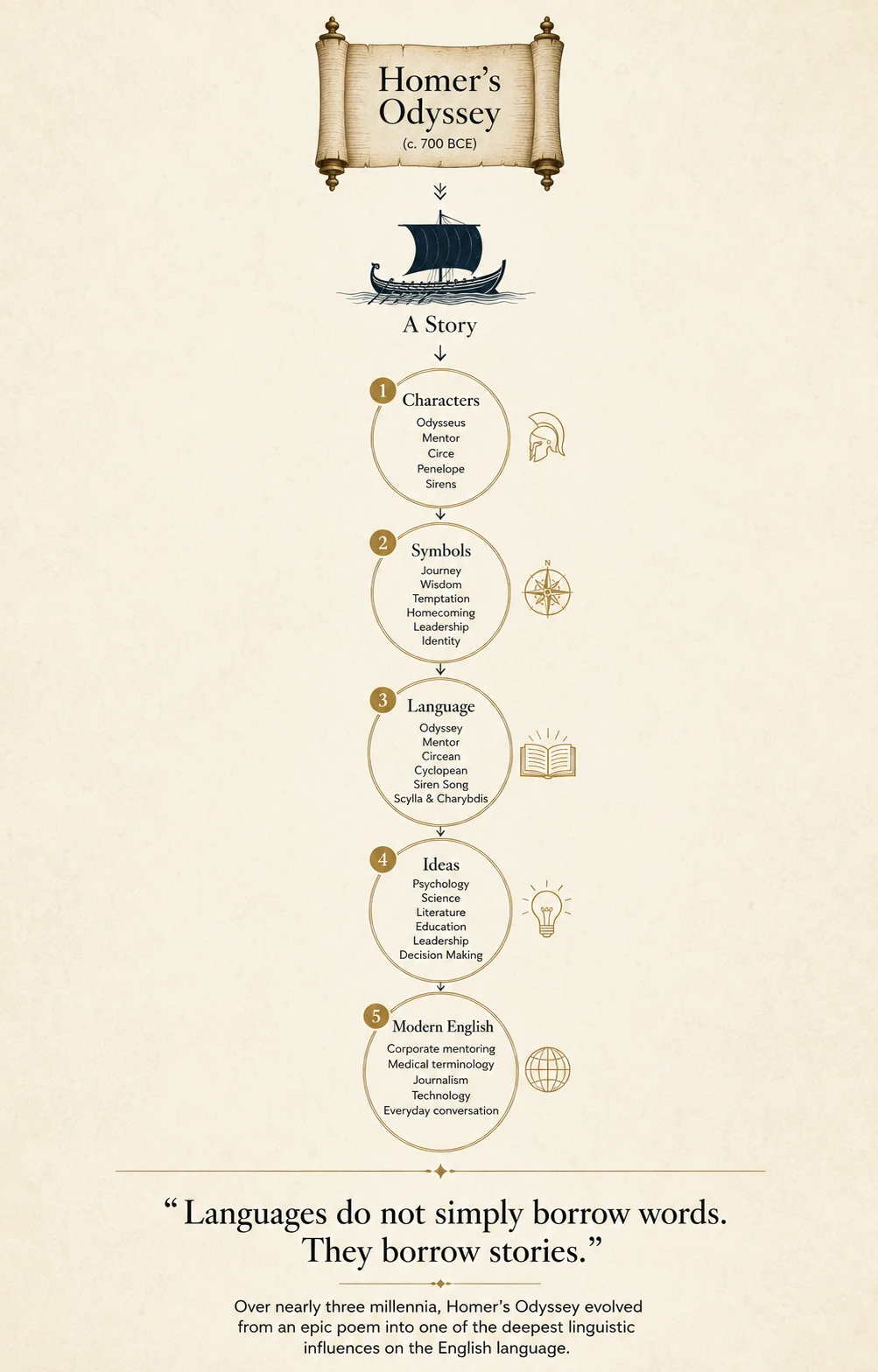
Long before the English language existed, a blind poet, or perhaps a highly sophisticated lineage of oral storytellers, wove a tale of a man desperately trying to get home. That story, The Odyssey, did not merely contribute a handful of mythological vocabulary words to the dictionary. It fundamentally shaped how English describes journeys, intelligence, temptation, leadership, homecoming, resilience, identity, and the human experience.
With Christopher Nolan's 2026 film adaptation putting Odysseus back in theaters and back in headlines, it is worth asking exactly how much of that story already lives inside the words you use every single day.
While its sister epic, the Iliad, gave Western literature its archetypes of martial glory and tragic fate, the Odyssey provided something far more adaptable: the enduring vocabulary of survival.
Here is the story of how an ancient poem sailed across millennia to anchor itself in modern dictionaries, medical journals, and our everyday conversations. After all, languages do not simply borrow words. They borrow stories. Stories become metaphors. Metaphors become idioms. And idioms become the very concepts through which we understand our modern lives.
The Long Journey to English: Why the Odyssey Survived
To understand how Homer's Odyssey influenced the English language, we must first look at the epic's own labyrinthine voyage through history. It is a miracle we have it at all.
Composed in Ionia around the late 8th or early 7th century BCE, the Odyssey consists of 12,110 lines of dactylic hexameter. In ancient Greece, it functioned as the bedrock of moral instruction, theological understanding, rhetoric, and pan-Hellenic cultural identity. Centuries later, Hellenistic scholars at the Library of Alexandria meticulously standardized the text into the 24 books we recognize today.
But languages die, and empires crumble. When the Western Roman Empire collapsed, knowledge of Greek in Western Europe essentially vanished with it. For nearly a thousand years, Western Europeans only knew of Odysseus (or his Latin counterpart, Ulysses) through fragmented summaries and references in texts by Roman authors like Virgil and Ovid.
The epic survived only because it was painstakingly preserved in the Greek East by Byzantine scholars. The cultural dam finally broke in 1453 with the fall of Constantinople. Fleeing the collapse of their empire, Greek scholars carried their ancient, fragile manuscripts to the intellectual havens of Italy, sparking a literary resurrection.
In 1488, the Greek scholar Demetrius Chalcondyles printed the editio princeps, the first printed edition, of the Homeric epics in Florence. Renaissance humanists devoured it. By the 16th century, English speakers were encountering the epic through Latin and French translations, and eventually, directly from the Greek.
Why did it catch fire in the English imagination, eclipsing countless other ancient texts? As a maritime nation entering an age of global navigation, colonial expansion, and naval supremacy, England saw its own reflection in the Odyssey. The epic's themes of maritime exploration, encounters with the monstrous "Other," and the desperate yearning for home deeply resonated with a society exploring the turbulent edges of the known world.
The Translation Battle: Capturing a "Complicated" Hero
Translating the Odyssey into English has never been a mere academic exercise; it is a mirror reflecting the evolving values of the English-speaking world. There is perhaps no better example of this than the 400-year linguistic war over a single Greek word: polytropos.
This adjective is the very first word used to describe Odysseus in the opening lines of the epic. A compound of poly- (many) and tropos (turn), it carries a brilliant, almost impossible ambiguity. Does it mean a man who has physically traveled many turning paths (much-wandered)? Or does it describe a man of many mental turns, a cunning, shifty, and versatile survivor?
Watching English translators grapple with polytropos is like watching the English language itself evolve to meet the cultural demands of its era:
| Year | Era | Translator | Rendering of “polytropos” | Approach |
|---|---|---|---|---|
| 1611 | Elizabethan | George Chapman | “that many a way wound with his wisdom” | Ornate, expanding metaphor typical of the era |
| 1725 | Neoclassical | Alexander Pope | “The man for wisdom's various arts renown'd” | Heroic couplets prizing intellect and rational order |
| 1791 | Romantic Shift | William Cowper | “for shrewdness famed And genius versatile” | Natural fidelity, rebelling against Pope's artificiality |
| 1887 | Victorian Medieval Revival | William Morris | — | Intentionally archaic diction and romance-associated words, medievalizing the epic's tone |
| 1900 | Plain English Movement | Samuel Butler | “ingenious hero” | Incredibly direct rendering |
| 1965 | Syntactic Era | Richmond Lattimore | “the man of many ways” | Strict literalism |
| 1996 | Kinetic Era | Robert Fagles | “the man of twists and turns” | Captured the frantic, kinetic energy of the Greek |
| 2017 | Psychoanalytic Era | Emily Wilson | “a complicated man” | Sparked intense philological debate |
As English literary culture moved from an external, action-oriented worldview (focused on tactical tricks) toward internal psychological complexity and moral ambiguity, the words chosen to describe the Odyssean archetype shifted alongside it.
Another famous Homeric phrase is oinopa ponton. English speakers almost universally know this as the "wine-dark sea". However, this beloved phrase was actually a poetic leap by early translators trying to capture the depth and luminosity of the original Greek, which literally translates closer to the rather bizarre "wine-faced".
The Ideas Homer Gave English
We often think of linguistic influence in terms of specific vocabulary words, but Homer's greatest gift to the English language was conceptual. The Odyssey provided the structural framework for how we discuss the human experience.
Before Odysseus, the literary archetype of heroism was Achilles from the Iliad, a paradigm of brute force (bia) and glorious, tragic death. The Odyssey introduced a radical new idea to Western narrative: metis, or cunning intelligence. Odysseus proved that the survival of the mind is just as heroic as the muscle of the sword. He is the original trickster-hero, forever altering how English literature conceptualizes leadership, resilience, and cleverness over strength.
The epic also gave us profound ways to discuss memory and identity.
How did nostalgia evolve from Greek? It began with the ancient concept of nostos (homecoming). In the 17th century, English writers combined nostos with algos (meaning pain) to create the word nostalgia. In modern English writing, an Odyssean nostos has become the ultimate metaphor for the search for identity and the painful yearning for a lost past.
Furthermore, the Greek concept of xenia (guest-friendship or hospitality) became a metaphorical litmus test for civilization in English literature. How a host treats a vulnerable wanderer signifies their ultimate moral standing.
Words Inspired by the Odyssey
When an ancient text is this powerful, its characters detach from their mythological roots to become everyday nouns and adjectives. But these words did not enter the dictionary as simple definitions. They arrived as fully formed stories.
Odyssey: The Name of the Game
Why is it called an odyssey? The answer traces back to the title of the poem itself, Odysseia.
When the word first appeared in Old English, borrowed via the Latin Odyssea, it strictly meant the text of the poem. But eventually, society needed a noun for a massive, transformative quest. The word underwent semantic broadening, a linguistic process where a word's meaning expands beyond its original boundary. Today, the noun odyssey has been completely stripped of its martial and nautical origins. In 1972, the creators of the world's first commercial home video game console named it the Magnavox Odyssey, cementing the word's association with interactive, electronic journeys. Today, the Honda Odyssey minivan utilizes the term to evoke notions of family adventure, reliability, and expansive experience.
Mentor: The Goddess in Disguise
Where does mentor come from? Picture an ancient king preparing to leave for a war that will last ten years. He must leave his household and his infant son behind. He entrusts their care to his old, wise friend, Mentor. Years later, when the goddess of wisdom, Athena, wants to guide Odysseus's struggling son, Telemachus, she assumes Mentor's physical form.
The name transitioned from a proper noun to a common noun in Europe largely due to François Fénelon's 1699 French text, Les Aventures de Télémaque. By 1750, Lord Chesterfield used it in a letter, cementing its transition into English as a trusted advisor.
In the 1970s, American sociologists and corporate HR departments decided they needed a word for the person receiving mentorship. Assuming the "-or" in Mentor functioned like the suffix in actor or director, they used morphological back-formation to create mentee. Etymologically, this is absurd. The "ment-" in Mentor has no semantic meaning related to guidance; it derives from the Proto-Indo-European root for mind/thinking. Nonetheless, this linguistic accident is now standard English.
Cyclopean: The Architecture of Giants
Picture Odysseus and his men trapped in a pitch-black cave. A massive boulder blocks the exit. Awaiting them is Polyphemus, a monstrous, uncivilized brute with a single, terrifying eye. The Greek word for round eye is Kyklōps.
Entering English in 1641, the adjective cyclopean evolved beyond monsters. By the 19th century, archaeologists used it to describe massive, prehistoric, unmortared masonry, implying that only a mythical giant could have lifted such enormous stones.
Circean: The Intoxicating Danger
Circe was the terrifyingly beautiful witch who invited Odysseus's starving men to her table, drugged their wine, and turned them into swine. First cited in the works of Geoffrey Chaucer in 1405, a Circean figure in English denotes a dangerously bewitching woman, and a Circean atmosphere represents an intoxicating, degrading magical allure.
Nepenthe and Moly: The Botanical Myths
In Book 4 of the epic, a drug from Egypt called nēpenthes (literally "not-sorrow") is introduced. Borrowed via French and Latin, English writers, most famously Edgar Allan Poe in The Raven, adopted the word nepenthe to describe any metaphorical potion or draft that brings forgetfulness of pain.
Similarly, moly was the magical herb with a black root and white flower that Hermes gave Odysseus to protect him from Circe's magic.
Many amateur etymologists incorrectly assume the exclamation "holy moly" refers to the magical Homeric herb, moly. There is actually no linguistic connection. "Holy moly" (or holey moley) originated around 1890 as a minced oath, a sanitized euphemism for saying "Holy Moses" or "Holy Mary". The Greek moly remains strictly confined to classical and botanical contexts.
Quick Vocabulary: Words from The Odyssey
| Modern English Word | First Known Usage | Greek Source | Modern Meaning & Evolution |
|---|---|---|---|
| Odyssey | Pre-1150 (Old English) | Odysseia | Epic journey; profound intellectual or spiritual quest. |
| Mentor | 1750 | Mentōr | An experienced and trusted adviser. |
| Cyclopean | 1641 | Kyklōps | Gigantic; denoting a type of ancient, massive masonry. |
| Circean | 1405 | Kirkē | Bewitching, dangerously attractive. |
| Homeric | 1594 | Homēros | Of epic proportions; relating to Homer's rhythmic style. |
English Idioms from Greek Mythology
The Odyssey is a masterclass in putting characters into impossible situations. These vivid narrative set-pieces captured the human imagination so completely that they crystallized into enduring English idioms.
Between Scylla and Charybdis
The Scene: Odysseus must navigate a narrow ocean strait. On one side is Scylla, a horrific six-headed monster; on the other is Charybdis, a ship-devouring whirlpool. He cannot fight both. He must make an agonizing choice: steer closer to Scylla and watch six of his men be eaten alive, or risk losing the entire ship to the whirlpool.
The Modern Idiom: What does Scylla and Charybdis mean today? Emerging in English texts in the mid-1500s, it denotes a choice between two equally perilous, undesirable, or ruinous alternatives. It is the ancient, elevated equivalent of being "between a rock and a hard place".
Penelope's Web
The Scene: While Odysseus is presumed dead, his wife Penelope is besieged by aggressive suitors demanding she choose a new husband. She promises to decide only after she finishes weaving a burial shroud for her father-in-law, Laertes. She weaves it by day, and unravels it by night, endlessly delaying the suitors through pure cunning.
The Modern Idiom: Popularized heavily in English by Robert Greene's 1587 prose romance Penelope's Web, the phrase now describes an endless, repetitive task, or a cleverly executed delaying tactic that produces no actual forward progress.
Siren Song / Siren Call
The Scene: As Odysseus's ship passes the island of the Sirens, he hears their enchanting voices, a sound so beautiful it lures sailors to jump to their deaths and crash their ships on the jagged rocks.
The Modern Idiom: What does siren song mean? Widely utilized in 19th-century literature and modern journalism, it describes an irresistible but highly dangerous appeal, distraction, or temptation that leads to ruin. Today, we use it to describe everything from toxic investments to deceptive political promises.
The Lotus-Eaters
The Scene: The exhausted crew lands on an island where the inhabitants consume a narcotic lotus flower. Eating it induces a state of dreamy oblivion, instantly erasing all desire to return home.
The Modern Idiom: Alfred, Lord Tennyson revived the concept in his 1832 poem The Lotos-Eaters to explore Victorian anxieties surrounding the British Empire and the opium trade. By 1855, the Connecticut Courant used "lotus-eat" as a verb to describe dreamy indulgence and the abdication of duty.
The Clinical Homer: Psychology and Decision-Making
Perhaps the most surprising aspect of Homer's legacy is its syndromization. Modern clinical and behavioral sciences continually borrow Odyssean narratives to describe complex, often tragic, psychological phenomena.
Why do modern doctors and psychologists still reach for Greek myth? Because doing so allows clinicians to encapsulate multifaceted human experiences within universally understood allegories.
What is a Ulysses Pact?
The Scene: Knowing the Sirens' song would break his mind and force him to jump into the sea, Odysseus commands his crew to tie him to the ship's mast and plug their own ears with wax. He explicitly orders them to ignore his future pleas for release.
The Modern Application: In medical ethics, psychiatry, and decision theory, a "Ulysses pact" (or contract) is a voluntary pre-commitment that binds your future self to a specific course of action. It is invoked when an individual anticipates a future state of diminished rational capacity.
- In Psychiatry: Patients with episodic illnesses, such as schizophrenia or bipolar disorder, legally consent to future treatment (such as hospitalization) even if their future, impaired self refuses it.
- In Technology: A "digital Ulysses pact" refers to technological architectures intentionally designed so the creator cannot override them. Things like end-to-end encryption or "warrant canaries" are structured to tie the hands of technology providers against government overreach, perfectly mimicking Odysseus's foresight to prevent catastrophic yielding to temptation.
The Ulysses Syndrome
In modern sociology, the "Ulysses syndrome" designates the extreme, chronic stress experienced by modern migrants. Coined in 2002 by Dr. Joseba Achotegui of the Universitat de Barcelona, the clinical framework draws a direct line to the ancient text. Just as Odysseus wept on the shores of Calypso's island, stripped of his identity and longing for Ithaca, modern migrants face toxic levels of stress resulting from forced loneliness, the dangers of the journey, and the failure of migratory goals. Crucially, it is classified not as a mental disorder, but as a normal human stress response to an extreme environment, maintaining the heroic resilience implied by its namesake.
A secondary, earlier use in 1972 medical diagnostic literature uses "Ulysses syndrome" to describe the harmful cascade of extensive diagnostic investigations triggered by a single false-positive lab result, an involuntary medical odyssey.
The Penelope Syndrome
In the field of pediatric neurology, there is a profound and tragic poetry to the "Penelope syndrome." It describes a severe, age-dependent epileptic encephalopathy (ESES). Children afflicted with this condition experience continuous electrical spike-wave activity during slow-wave sleep. This abnormal nighttime activity interferes with neuroplasticity, effectively erasing the learning and memory consolidation the child achieved during the day. The medical community adopted the moniker because the biological process of "spinning during the day, spiking [unweaving] during the night" directly mirrors Penelope unweaving her tapestry in the dark to delay her suitors.
The Telemachus Complex
While Sigmund Freud gave us the Oedipus complex (positing a subconscious desire to usurp the father), contemporary psychoanalyst Massimo Recalcati popularized the "Telemachus complex" as a conceptual counterweight. It describes the longing of a child for a missing father figure who represents order, structure, and future meaning. It encapsulates modern youth facing the "decline of the father," yearning for a mentor to guide them out of societal chaos, much as young Telemachus sought Odysseus to restore order to Ithaca.
Science Inspired by Homer
The influence of the Odyssey stretches beyond the human mind and into the natural sciences, serving as foundational nomenclature across biology, astronomy, and geology.
- The Microscopic Cyclops: The single-minded brutality of the Cyclops Polyphemus has heavily influenced biological taxonomy. In the microscopic realm, Polyphemus pediculus is a predatory water flea whose most distinguishing morphological feature is a massive, single compound eye containing roughly 130 ommatidia. This terrifying, singular gaze allows it to hunt planktonic prey, perfectly mirroring the mythic giant. Similarly, the giant silk moth Antheraea polyphemus is named for the large, singular, purplish eyespots on its hindwings used to startle predators.
- The Avian Penelope: The bird genus Penelope comprises a group of turkey-like arboreal guans found in the Neotropics. The naming finds its roots in ancient etymological debates; classical commentators suggested Penelope's original name was altered after she was thrown into the sea as an infant and rescued by a flock of ducks with patterned feathers, known in Greek as pēnelopes.
- The Winds of Aeolus: Aeolus, the mythological keeper of the winds, bequeathed his name to both the earth sciences and marine biology. "Aeolian processes" refer to how wind shapes the surface of the Earth (or other planets) through erosion and sand deposition. In marine biology, the nudibranch (sea slug) genus Aeolidia takes its name from Aeolus, as the respiratory structures covering their backs ripple in ocean currents exactly like wind-blown hair or fields of grass exposed to aeolian forces.
Literary Aftershocks: The Skeleton of Modern Storytelling
It is impossible to discuss the Odyssey without acknowledging its monumental impact on English literature. The epic provided a thematic skeleton upon which centuries of authors have draped their own cultural anxieties.
- The Renaissance: William Shakespeare drew upon the Homeric tradition in Troilus and Cressida to explore themes of value, time, and human frailty. John Milton utilized Odyssean motifs in Paradise Lost and Comus, featuring the witch Circe and the protective herb moly to explore theological concepts of temptation and divine grace.
- The Victorian Era: Alfred, Lord Tennyson fundamentally reinterpreted Odyssean themes for his era. In his poem Ulysses, he captures the restlessness of a hero who cannot endure domestic stasis, famously declaring, "To strive, to seek, to find, and not to yield".
- Modernism: James Joyce's 1922 masterpiece, Ulysses, maps the sprawling Mediterranean voyage onto a single day in Dublin. By rendering grand Homeric tropes through the lens of ordinary urban life, Joyce systematically dismantled the Victorian sanitization of the epic.
- Subversion in Contemporary Fiction: Modern authors frequently subvert the epic to elevate marginalized voices. Margaret Atwood's The Penelopiad shifts the narrative focus to Penelope and her twelve hanged maids to interrogate patriarchal violence. Madeline Miller's Circe transforms the terrifying witch into a sympathetic protagonist exploring female autonomy and divine isolation. Derek Walcott's epic poem Omeros transplants the Homeric narrative to the Caribbean, using the echoes of the Odyssey to explore post-colonial identity and the trauma of the Middle Passage.
Why Homer Still Lives Inside Modern English
Why has humanity never stopped retelling this story?
It survived because it is essentially a story about endurance. We continue to reach for Homeric language because the core anxieties of the Odyssey are universally human. As long as we are forced to make impossible choices, we will navigate between Scylla and Charybdis. As long as we fear our own weaknesses, we will bind our future selves with Ulysses pacts. As long as we seek guidance in a chaotic world, we will search for Mentors.
English did not merely inherit Homer's words. It inherited Homer's way of understanding the human experience.
Languages do not simply borrow words. They borrow stories.
The next time you describe a difficult project as an odyssey, seek a mentor in the workplace, warn a friend against a siren song, or speak of nostalgia, pause for a moment. You are not just speaking modern English. You are unknowingly keeping a 3,000-year-old story alive, breathing fresh life into an ancient survivor who is still, after all these centuries, just trying to find his way home.
Key Takeaways
- The Odyssey nearly didn't survive at all: knowledge of Greek vanished from Western Europe for almost a thousand years, and the epic only reached English through Byzantine preservation and the 1453 fall of Constantinople.
- Homer's biggest legacy is conceptual, not lexical: metis (cunning intelligence), nostos (homecoming), and xenia (hospitality) reshaped what English literature considers heroic, long before any single word entered the dictionary.
- One word can carry 400 years of cultural history: tracking how translators rendered polytropos from 1611 to 2017 is really a history of how English-speaking culture's values changed.
- Everyday words hide entire myths: mentor, odyssey, cyclopean, and circean all arrived in English as fully formed stories, not just borrowed roots.
- The idioms still do real work: Scylla and Charybdis, Penelope's Web, siren song, and the Lotus-Eaters remain the sharpest shorthand English has for dilemmas, delaying tactics, temptation, and complacency.
- Modern medicine keeps minting new Homeric terms: the Ulysses pact, Ulysses syndrome, Penelope syndrome, and Telemachus complex show the epic is still actively naming phenomena we didn't have words for before.
Frequently Asked Questions
The word traces back to the poem's own Greek title, Odysseia. When it was borrowed into Old English via Latin, it strictly meant the text of the poem itself. Over time the word underwent semantic broadening, a linguistic process where a word's meaning expands beyond its original boundary, until society needed a general noun for any long, transformative quest. Today an odyssey has nothing to do with Homer at all, whether it names a minivan or a difficult project at work.
In the Odyssey, Mentor is the old friend Odysseus leaves in charge of his household and his infant son before sailing off to war. When the goddess Athena wants to guide the struggling son, Telemachus, she disguises herself as Mentor. The name shifted from a proper noun to a common noun largely through François Fénelon's 1699 French text Les Aventures de Télémaque, and was cemented in English by Lord Chesterfield's letters by 1750. The word mentee, coined in the 1970s by back-formation, is a separate and etymologically unrelated accident: the ment- in Mentor comes from a Proto-Indo-European root for mind, not from any suffix meaning guidance.
It describes a choice between two equally dangerous or ruinous alternatives, with no safe option available. It comes from the strait Odysseus must sail through, flanked by a six-headed monster on one side and a ship-swallowing whirlpool on the other. The idiom emerged in English texts in the mid-1500s and is the more literary, classical equivalent of being caught between a rock and a hard place.
A siren song describes an irresistible but genuinely dangerous appeal, distraction, or temptation that leads to ruin, drawn from the Sirens whose enchanting voices lured sailors to wreck their ships on the rocks. It is widely used in 19th-century literature and modern journalism to describe everything from toxic investments to deceptive political promises.
A Ulysses pact is a voluntary pre-commitment that binds your future self to a specific course of action, used when you anticipate a future state of diminished judgment. The term comes from Odysseus ordering his crew to tie him to the ship's mast and ignore his own future pleas so he can hear the Sirens without steering the ship toward them. It shows up today in psychiatric advance directives and in technology deliberately designed so its own creator cannot override it, such as end-to-end encryption.
Nostalgia was coined in the 17th century by combining the Greek nostos, meaning homecoming, with algos, meaning pain. Nostos is the central engine of the Odyssey itself, Odysseus's decade-long struggle to return home to Ithaca. An Odyssean nostos has become the standard metaphor in English for the search for identity and the painful longing for a lost past.
Because a well-known myth lets clinicians compress a complex, multifaceted human experience into a single, universally understood reference. Ulysses syndrome, Penelope syndrome, and the Telemachus complex are all modern clinical terms, coined in the 20th and 21st centuries, that borrow a Homeric character to name a real and often previously unnamed condition.
No, despite the coincidence in spelling. Moly is the magical herb Hermes gives Odysseus to protect him from Circe's magic, and it remains confined to classical and botanical contexts. The exclamation holy moly (or holey moley) originated separately around 1890 as a minced oath, a sanitized substitute for saying Holy Moses or Holy Mary.

Our English vocabulary app: FSRS spaced repetition, 5,000+ curated words across 119 topic groups, CEFR A1 to C2. Explore your mastery with the beautiful Vocabulary World feature.