Why Cramming Vocabulary Doesn't Stick (And What Does)
The difference between recognizing a word and actually owning it, and what the cognitive science of memory says you should do instead.
- Introduction: The Mystery of the Vanishing Word
- The Liar in Your Brain: Metacognition and the Fluency Illusion
- The Architecture of Memory: Two Distinct Dials
- The Default State is Decay: Understanding the Forgetting Curve
- Mental Heavy Lifting: Cognitive Load and Depth of Processing
- The Power of the Struggle: Active Retrieval and the Testing Effect
- Building the Web: Elaborative Processing and the Generation Effect
- The Right Arena: Context and Transfer-Appropriate Processing
- The Motivation to Remember: The Involvement Load Hypothesis
- Against the Clock: Spacing, Interleaving, and Confident Mistakes
- An Evidence-Based Workflow for Permanent Lexical Acquisition
- Key Takeaways
- Conclusion: The Articulation Mandate
- Frequently Asked Questions
- Why a word can feel completely "learned" and still vanish the moment you need it
- The two independent dials, storage strength and retrieval strength, that actually govern memory
- Why forgetting is a required part of learning, not a failure of it
- A 9-step, evidence-based workflow for turning any new word into permanent vocabulary
Introduction: The Mystery of the Vanishing Word
A professional sits in a quiet coffee shop, reading a sophisticated industry publication. Halfway down the page, they encounter the word ephemeral. The reader pauses, pulls out their phone, and looks up the definition. The context suddenly clicks perfectly. Nodding in agreement, they highlight the word in yellow, perhaps jotting it down in the margins of a notebook.
At that exact moment, a profound feeling of competence washes over the reader. The word feels intimately familiar. A silent agreement is made between the reader and their brain: I have learned this word.
Three days later, that same professional is sitting in a high-stakes interview. An opportunity arises to use ephemeral to perfectly articulate a complex thought. The underlying concept is crystal clear in their mind. But the specific lexical label, the word itself, is entirely inaccessible. The mind goes completely blank. The speaker stumbles, eventually substituting a much weaker, generic term. They are left deeply frustrated by the realization that a word they definitively "learned" has vanished without a trace.
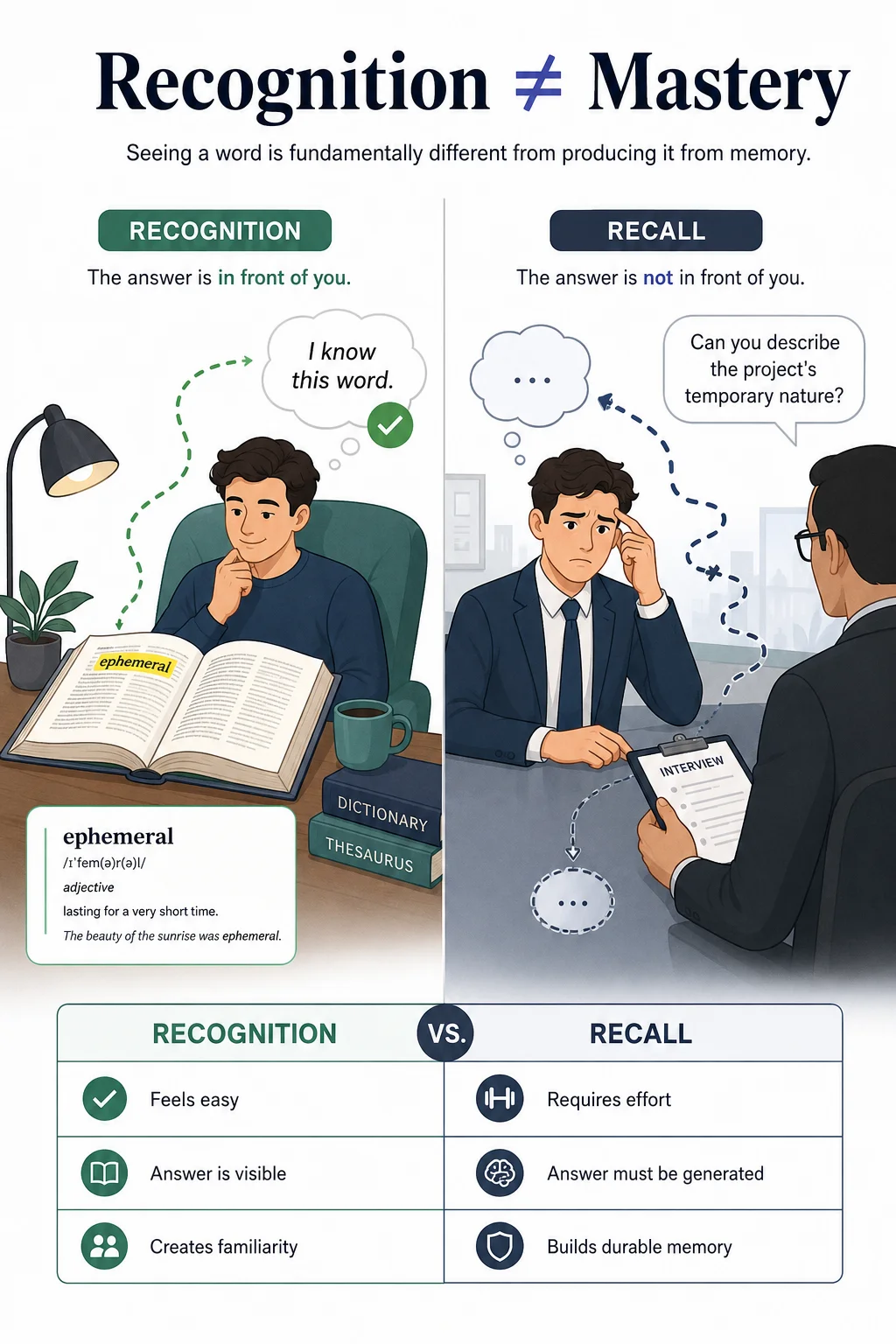
This precise scenario is universally experienced. It happens when business leaders attempt to elevate their communication, when students sit for competitive exams, when language enthusiasts practice a second language, and when readers attempt to adopt the vocabulary of classic literature.
Why do we always forget words we thought we had learned?
The frustration stems from a fundamental misunderstanding of the science of memory. The core issue is that human beings persistently mistake familiarity for learning.
Seeing a word multiple times creates recognition. Recognition is akin to spotting a familiar face in a crowded grocery store. You know you have seen the face before, but that is the absolute extent of the relationship. Recall, on the other hand, is the ability to remember that person's exact name, their background, and how you know them.
Owning a vocabulary word is like owning a physical tool in a workshop; recognition is merely pointing at that tool through a storefront window.
Recognition feels like total mastery, but it is exceptionally fragile. It evaporates the moment the word must actually be generated from the brain and used in a natural environment. True vocabulary acquisition begins only when a word can be recalled independently from memory, used naturally in rapid speech, recognized across novel contexts, understood precisely in its nuances, and distinguished effortlessly from similar synonyms. To transform fleeting recognition into permanent fluency, we must deconstruct why traditional memorization fails, examine the mechanical realities of how memory functions, and adopt the counterintuitive strategies required to permanently own a word.
The Liar in Your Brain: Metacognition and the Fluency Illusion
Most people believe that if studying feels easy, they are successfully learning. Cognitive science reveals the exact opposite.
To understand why vocabulary like pragmatic or meticulous is forgotten so rapidly, we must first look at why learners persistently rely on highly ineffective study methods. When people want to learn words, they typically resort to passive rereading, highlighting, and scanning neat lists of definitions. They do this because of metacognition: the mind's internal system for monitoring, judging, and directing its own learning processes.
Our internal monitoring system is easily tricked. We make judgments about our own learning based on the cues present during study time. According to the cue-utilization model proposed by cognitive psychologist Asher Koriat, these fall into two categories: intrinsic cues, which relate to how difficult the material seems, and mnemonic cues, which relate to the subjective "feeling" of processing the information.
When you read a highlighted vocabulary list, or look at a digital flashcard with the answer already exposed on the screen, the cognitive processing feels incredibly smooth and effortless. Your visual cortex processes the text fluently. The fatal flaw in this process is that the brain severely misinterprets this perceptual fluency as durable, deeply embedded learning.
Because the definition of a target word is so easily processed when it is sitting directly in front of your eyes, you falsely predict that it will be equally easy to retrieve from your mind later during an exam or a live conversation. Experiencing a high judgment of learning, you falsely conclude the material is mastered. Satisfied, you prematurely stop practicing.
The illusion of competence reveals exactly why passive review is a dead end. Passive review relies entirely on external cues (the physical text on the page or the pixels on the screen) to prop up your memory. When those external crutches are inevitably removed during actual writing or speaking, the internal memory trace is exposed as entirely non-existent.
Overcoming this illusion requires abandoning the comfort of passive reading and engaging in methodologies that accurately reflect true, unaided retention.
The Architecture of Memory: Two Distinct Dials
We often think of a memory like a battery, either fully charged (learned) or completely dead (forgotten). But to permanently capture vocabulary, we need a more sophisticated mental model.
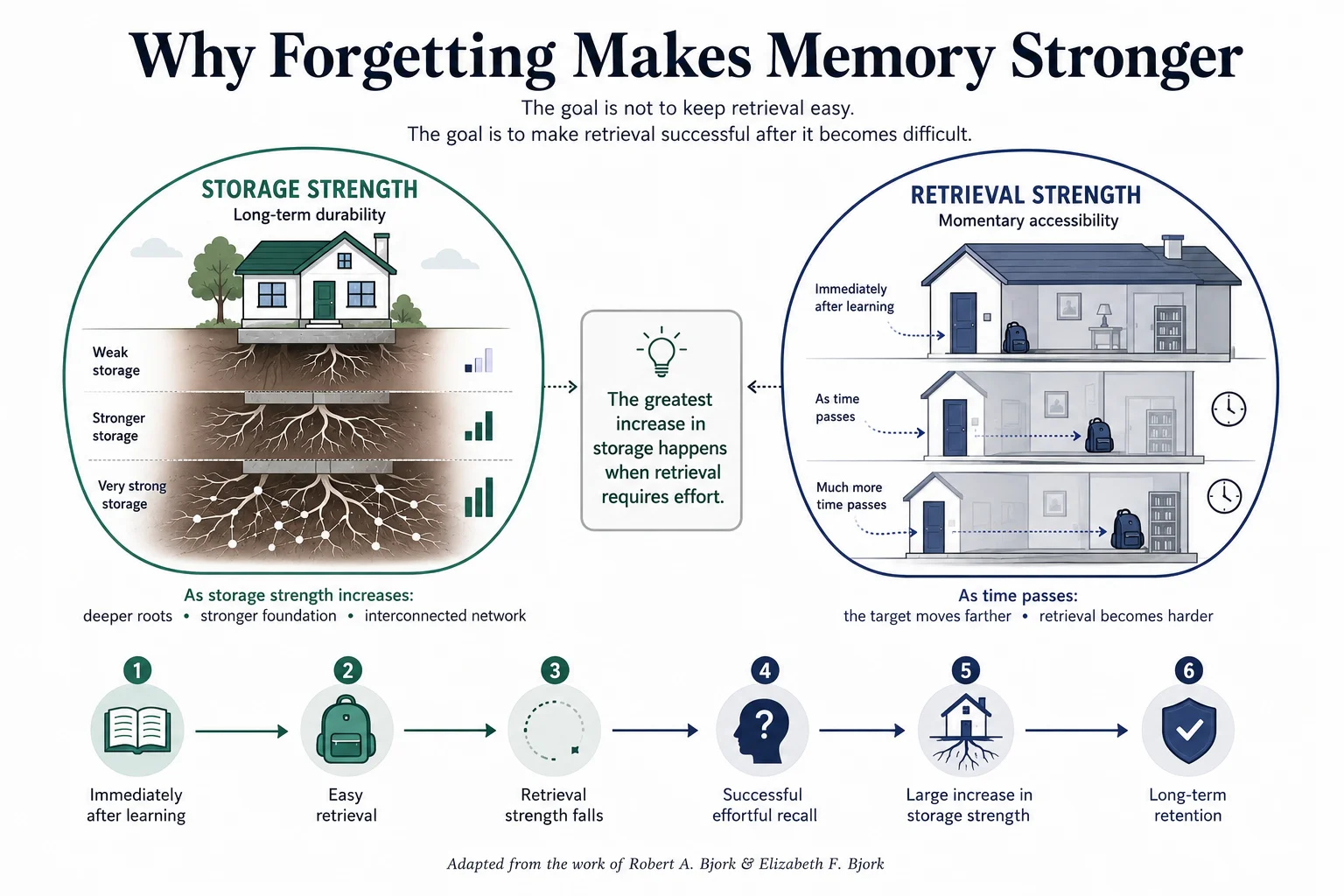
In 1992, cognitive psychologists Robert and Elizabeth Bjork proposed a vastly different framework called the "New Theory of Disuse". They argued that memory does not exist on a single, linear spectrum. Instead, every single memory trace possesses two completely independent indices, like two separate dials on a soundboard: storage strength and retrieval strength.
Storage strength refers to how deeply and durably information is entrenched in long-term memory. Think of this as the size of the foundation a house is built upon. It is a measure of how well a word is integrated with other concepts and neural networks. Storage strength builds up gradually over time and, theoretically, it never decays. Once a piece of knowledge achieves high storage strength, it remains in the brain permanently, acting as a lifelong cognitive asset.
Retrieval strength, conversely, measures the momentary, immediate accessibility of a memory. Think of this as how close the item is to the front door of that house right now. It indicates how easily a word can be pulled into working memory at a specific instant, based on current environmental cues. Retrieval strength spikes to its absolute maximum immediately after encountering a word, but it decays rapidly over hours and days if the word is not used.
Understanding the interplay between these two independent strengths is vital for retaining vocabulary permanently.
The Memory Profile Matrix
| Storage Strength | Retrieval Strength | Real-World Lexical Example |
|---|---|---|
| High | High | One's own name, or highly frequent native vocabulary. Effortlessly retrieved and permanently stored. |
| High | Low | A word learned for a middle school spelling bee. Difficult to recall on demand right now, but relearned instantly if prompted. |
| Low | High | A new word just looked up in a dictionary for a novel currently being read. Easily recalled today, but will be entirely forgotten next month. |
| Low | Low | A highly obscure word seen for the very first time. |
The most counterintuitive aspect of the Bjorks' theory is the dynamic, inverse relationship between these two dials during the learning process.
The rule is this: the degree to which storage strength increases during learning is inversely related to the current retrieval strength.
If you review the word ubiquitous immediately after seeing it (when retrieval strength is at its absolute maximum), your brain exerts zero effort. Because there is no effort, there is almost zero increase in storage strength. The learning event is cognitively wasted.
However, if you wait until the word has faded from your immediate memory (when retrieval strength has dropped to a low level) and then you struggle to successfully recall it, that intense, effortful cognitive process triggers a massive increase in permanent storage strength.
Recognition tells you what you know today. Recall tells you what you'll know tomorrow.
Forgetting is not a flaw in the human operating system. It is a strict biological requirement for durable learning. Forgetting is what focuses remembering. Memories must be allowed to decay in their momentary accessibility so that the subsequent act of retrieval can effectively reinforce their permanent, lifelong storage.
The Default State is Decay: Understanding the Forgetting Curve
Most people assume forgetting is a sign of a failing intellect. In reality, memory decay is your brain functioning exactly as designed.
The scientific inquiry into exactly how fast we forget dates back to the 1880s, driven by the pioneering work of German psychologist Hermann Ebbinghaus. Ebbinghaus was determined to study memory formation in a completely pure state, devoid of any prior linguistic associations. To do this, he created thousands of nonsense syllables, meaningless consonant-vowel-consonant combinations like "WID", "BOK", or "ZOF". He painstakingly memorized these lists and rigorously tested his own retention at highly specific intervals.
The resulting data formed the very first quantitative model of memory decay, immortalized in science as the Forgetting Curve. The findings were stark and, for anyone trying to learn a language, somewhat alarming: human memory decays at an exponential rate. Ebbinghaus discovered that almost half of all newly acquired, meaningless information is forgotten within the first 20 minutes.
The Trajectory of Forgetting
| Time Since Learning | Information Lost |
|---|---|
| 20 minutes | ~42% |
| 1 hour | ~56% |
| 9 hours | ~64% |
| 24 hours | ~67–70% |
| 31 days | ~79% |
Data approximates Ebbinghaus's original 1885 savings scores for nonsense syllables.
After a single day, roughly two-thirds of the material you learned is inaccessible. After a month, retention drops to a dismal 20 percent. This rapid, steep decay perfectly illustrates why cramming vocabulary the night before a presentation or an exam yields universally poor long-term results. The brain is ruthlessly efficient; it rapidly jettisons information that is not actively reinforced.
While the original Ebbinghaus experiments utilized nonsense syllables, the underlying mathematical model holds true for any new information that lacks heavy initial semantic meaning. However, Ebbinghaus also documented specific variables that drastically alter the trajectory of this curve. When material is highly meaningful or deeply connected to existing knowledge, the curve flattens significantly, decaying at a much slower rate.
Furthermore, physiological factors play a crucial role in combating this decay. Modern replications and neurological extensions of Ebbinghaus's work confirm the absolute necessity of memory consolidation. This physical process occurs predominantly during slow-wave sleep. During deep sleep, recently encoded memory traces are automatically replayed across thalamic circuits. They are integrated into preexisting neocortical knowledge structures, effectively doing part of the retention work on the learner's behalf while they rest.
Despite the benefits of sleep and meaning, the baseline reality remains unchanged: the human brain is fundamentally designed to forget. The cognitive apparatus aggressively prunes information that it deems non-essential for future survival or utility. To ensure a word like resilient stays with you, you must utilize strategies that artificially convince the brain that it is absolutely essential to keep.
Mental Heavy Lifting: Cognitive Load and Depth of Processing
We naturally assume that reading a dictionary definition for ten minutes constitutes studying. But time spent staring at a page does not equal learning.
Convincing the brain to retain a word requires moving far beyond surface-level exposure. Cognitive psychology differentiates heavily between shallow processing and deep processing.
According to the Levels of Processing framework established by Fergus Craik and Robert Lockhart, the depth of your mental engagement during the initial moment of learning directly dictates how well that information will be retained in the long term.
Noting the visual shape of a word, looking at its spelling, or briefly skimming its dictionary definition constitutes shallow processing. Analyzing its ancient root structure, deliberately comparing it to similar synonyms, and actively generating a highly original sentence constitutes deep processing. Memory retention is not a stroke of luck; it is a direct byproduct of this deep mental engagement.
The design of the learning experience must also account for human cognitive architecture. Educational psychologist John Sweller's Cognitive Load Theory maps out exactly how working memory processes new information. Working memory is a severely limited bottleneck, capable of holding only a few distinct pieces of information simultaneously. Sweller categorized cognitive load into three distinct types:
- Intrinsic Load: The inherent difficulty and complexity of the word or concept itself.
- Extraneous Load: Distractions, poor formatting, or highly confusing, overly academic definitions that waste working memory resources without contributing to actual learning.
- Germane Load: The productive mental effort deliberately directed toward integrating the new word into long-term memory schemas.
Passive review methods demand almost zero germane cognitive load. The learner merely processes the visual information without forming deep semantic connections. To permanently own a vocabulary word, study strategies must drastically minimize extraneous load (by using clear, unambiguous definitions and rich contexts) while aggressively maximizing germane load (by forcing the brain to exert effort to build neural pathways). Exploring related topics, such as root words and etymology, can further reduce intrinsic load by revealing the logical, historical building blocks of complex vocabulary.
Engineering this germane load effectively involves the concept of "chunking". Popularized by learning scientist Barbara Oakley, chunking acknowledges that the brain operates in two primary modes: the focused mode (highly attentive, concentrated thought) and the diffuse mode (relaxed, associative thinking).
Building a permanent vocabulary requires using the focused mode to actively bind the definition, spelling, and pronunciation of a word into a single, cohesive neural "chunk". Once chunked, the diffuse mode can begin forming associative links between this new word and your preexisting knowledge. This allows the word to be retrieved effortlessly as a single unit rather than a fragmented concept.
The Power of the Struggle: Active Retrieval and the Testing Effect
Most people believe tests are just dipsticks, tools used to measure knowledge after the actual learning has already taken place. Science tells a very different story.
If passive review is the enemy of deep processing, what is the ultimate alternative? The answer lies in one of the most robust and heavily replicated findings in all of cognitive science: active recall practice, driven by the Testing Effect.
Groundbreaking research by Henry Roediger and Jeffrey Karpicke fundamentally shifted our understanding of assessment. They demonstrated that the act of retrieving information from memory is itself a potent learning event. The physical act of recalling a word permanently alters the memory trace, making it vastly more accessible in the future.
In a landmark 2006 study, Roediger and Karpicke had students study educational texts. One group studied the material repeatedly, engaging in restudy. Another group studied the material once and then took a free-recall test, generating as much information as possible entirely from their own minds without looking at the source material. This was pure retrieval practice. No feedback was given to the tested group.
The results were astonishing. When the students were assessed merely five minutes later, the restudy group performed better. This demonstrated that massed reading is highly effective for immediate, short-term performance.
But when tested two days and one week later, a dramatic and permanent reversal occurred. The group that utilized retrieval practice vastly outperformed the restudy group. They retained significantly more information over the long term, despite having spent far less time actually looking at the text.
The implication for learning vocabulary is profound. A learner who rereads a word list ten times will perform exceptionally well if tested immediately, but will forget nearly all of it within a week. A learner who reads the list once and then actively forces themselves to retrieve the definitions from memory, even if they struggle, will secure that vocabulary in long-term storage.
Memory grows through retrieval, not exposure. Memory is a path through a dense forest. Every successful retrieval clears the brush, widens the trail, and paves the road for future access. Passive reading merely involves looking at a map of the forest without ever setting foot on the trail.
Testing little and often is not about stressful assessment; it is about effortful learning. The struggle to recall a word without looking at the definition is a "desirable difficulty". Coined by Robert Bjork, this term describes environmental conditions that make learning feel slower, harder, and more error-prone in the short term, but which biologically yield far superior long-term retention.
Building the Web: Elaborative Processing and the Generation Effect
What actually happens in the brain during this "desirable struggle"?
When you attempt to actively recall a target word, your brain does not simply access a perfectly organized, alphabetical mental dictionary. Instead, it initiates a frantic, highly effortful search through a complex semantic network.
According to the spreading activation model, this internal search activates multiple related concepts, synonyms, and contextual clues simultaneously. This phenomenon forms the basis of the Elaborative Retrieval Hypothesis proposed by cognitive psychologist Shana Carpenter.
Imagine you are trying to recall the word ephemeral using the mental cue "short-lived". Your brain might quickly activate candidates like "brief," "temporary," or "fleeting" before successfully arriving at the target word ephemeral. This effortful search process co-activates all of these related semantic items. It weaves the target word into a much richer, more elaborated web of associations.
In the future, any of these newly associated concepts can serve as a sturdy bridge to retrieve the target word. Passive rereading bypasses this vital search entirely. When the answer is provided instantly on the page, no semantic network is activated, no struggle occurs, and no elaborative pathways are formed.
Additionally, the Mediator Effectiveness Hypothesis, championed by researchers Pyc and Rawson, suggests that retrieval practice encourages learners to generate and utilize internal mediating links. These links (such as personalized mnemonic devices or vivid contextual images) connect the initial cue to the target word. Each successful retrieval attempt refines and strengthens this mediator, ensuring faster and more accurate lexical access in the future.
This active creation of meaning is known as the Generation Effect. This principle dictates that information generated from within the mind is remembered far better than information simply read from an external source. Integrating memory techniques and word families into study routines capitalizes heavily on these powerful elaborative networks.
The Right Arena: Context and Transfer-Appropriate Processing
Most people think if they have memorized a word perfectly on a flashcard, they have learned it for real life. But the brain is incredibly literal.
A highly common and frustrating pitfall in lexical acquisition is mastering a word perfectly on an app, but remaining entirely unable to summon that same word during a live conversation or while drafting a professional email. This jarring failure is explained by the cognitive principles of Encoding Specificity and Transfer-Appropriate Processing.
Endel Tulving and Donald Thomson introduced the Encoding Specificity Principle in 1973. They demonstrated that memories are never stored in a vacuum. They are intrinsically bundled with the environmental, physical, and cognitive context that was present during the initial encoding. The likelihood of successfully retrieving a word later depends heavily on whether the cues present during retrieval match the exact cues that were present during encoding.
Expanding on this foundational idea, Morris, Bransford, and Franks formulated the concept of Transfer-Appropriate Processing (TAP) in 1977. TAP dictates that memory performance does not rely solely on the depth of processing. It relies on the precise alignment between the cognitive processes engaged during study and those required during the actual application.
In a classic experiment, they showed that if individuals encoded words by focusing on what they rhymed with, they performed better on a rhyming test than individuals who encoded the words based on semantic meaning. The type of test must match the type of processing.
The Transfer Alignment
| Practice Method (Encoding) | Performance Demand (Retrieval) | Result |
|---|---|---|
| Reading a word list silently | Recognizing the word in a novel | High Transfer |
| Flipping visual flashcards | Speaking dynamically in a meeting | Low Transfer |
| Writing original sentences | Drafting professional emails | High Transfer |
| Listening to an audio definition | Writing an academic essay | Low Transfer |
If a learner studies vocabulary exclusively by looking at written words on a screen and silently reciting their definitions, they are biologically optimizing their brain strictly for visual recognition and silent recall. When they are subsequently thrust into a dynamic spoken conversation, the brain is suddenly tasked with auditory processing, rapid motor articulation, and real-time syntactic construction. The cognitive processes do not match. The transfer fails completely.
To permanently own a vocabulary word for active use, the practice conditions must meticulously mimic the actual performance conditions. If the goal is to sound more articulate in meetings, the learner must practice retrieving the words aloud, inserting them into spoken sentences, and responding to auditory cues. This is the absolute essence of context learning.
The Motivation to Remember: The Involvement Load Hypothesis
We often hope that simply reading widely will naturally, passively build our vocabulary. But exposure alone is fundamentally insufficient.
In the specific realm of second language acquisition and vocabulary learning, researchers Batia Laufer and Jan Hulstijn proposed the Involvement Load Hypothesis to measure exactly how effective a learning task will be. This framework predicts how effectively a word will be acquired based on the cognitive and motivational load required to complete the task. The hypothesis posits that vocabulary retention is determined by three distinct components:
- Need (Motivational): The degree of necessity to learn the word. Is the word provided externally by a teacher or a textbook (moderate need), or does the learner actively want to find a specific word to express their own internal thought (strong need)?
- Search (Cognitive): The effort required to find the word's meaning or form. Looking up an unknown word in a dictionary requires search (present); reading a word with a translation printed directly beside it does not (absent).
- Evaluation (Cognitive): The process of comparing a word against other options to ensure it fits the specific context. Simply filling in a blank with a provided word involves moderate evaluation, while deciding which synonym best fits a highly nuanced original sentence requires strong evaluation.
The Involvement Index
| Component | Index 0 (Absent) | Index 1 (Moderate) | Index 2 (Strong) |
|---|---|---|---|
| Need | No requirement to know the word. | Externally required (e.g., to pass a quiz). | Internally driven (e.g., wanting to express a specific thought). |
| Search | Definition/translation is provided on the page. | Must actively look up the definition or word form. | N/A |
| Evaluation | No comparison with other words is needed. | Comparing word against given context (gap-fill). | Using the word to construct an original, novel sentence. |
Adapted from Laufer & Hulstijn's Involvement Load metrics.
Tasks that combine a high degree of Need, Search, and Evaluation yield the highest possible involvement load and the greatest vocabulary retention. Writing an original sentence to express a personal opinion using a newly encountered word like pragmatic is a prime example of this. Conversely, passive reading with marginal glosses scores very low on the involvement index and results in rapid, predictable forgetting.
This research definitively confirms that exposure alone does not build a powerful vocabulary. The learner must have a genuine need to use the word, must exert effort to retrieve or locate it, and must critically evaluate its precise contextual fit.
Against the Clock: Spacing, Interleaving, and Confident Mistakes
Most people assume cramming works because it yields high test scores the next day. But cramming is merely renting information; it is never buying it. Once a word has been actively retrieved and deeply processed in context, the neural trace must be strictly maintained against the relentless forces of the forgetting curve.
The Spacing Effect
Spacing out practice sessions over time produces vastly superior long-term retention compared to massing all study into a single, extended session. Spaced repetition artificially forces the brain to allow retrieval strength to drop over time. This purposeful delay makes the subsequent retrieval attempt significantly harder, which in turn spikes permanent storage strength dramatically.
Research by Jeffrey Karpicke and Henry Roediger comparing different spacing schedules (expanding intervals versus equal intervals) reveals a crucial factor. The key is delaying the first retrieval attempt long enough to introduce a desirable difficulty. Expanding schedules (reviewing after 1 day, then 3 days, then 10 days) are highly effective for maintaining learner motivation by keeping early success rates high. However, the fundamental mechanism driving the memory consolidation is the spaced, effortful retrieval itself.
Interleaving
Another highly counterintuitive strategy is interleaving. This involves mixing different topics or types of vocabulary during a study session, rather than focusing on one category at a time in blocks.
Studying ten adjectives related strictly to "anger" consecutively creates a false sense of fluency. By interleaving words from entirely different semantic categories or grammatical structures, the brain is forced to constantly reset its parameters and actively discriminate between concepts. This deep discrimination sharpens the precise boundaries of each word's meaning. It perfectly mirrors how words are encountered in the chaos of the real world.
The Hypercorrection Effect
During active retrieval practice and interleaving, learners will inevitably make mistakes. Surprisingly, cognitive science reveals this is highly beneficial.
Research by Brady Butterfield and Janet Metcalfe identified the "Hypercorrection Effect". This demonstrates a robust, paradoxical finding: errors made with high confidence are actually easier to correct and remember over the long term than errors made with low confidence. This holds true provided that immediate, corrective feedback is given.
When a learner highly confidently supplies the wrong word, the subsequent corrective feedback generates a severe metacognitive mismatch. The brain experiences a psychological sense of surprise, or an "aha" moment. This surprise acts as a powerful attentional anchor, capturing cognitive resources and deeply encoding the correct answer into long-term memory. Guessing and failing is not a setback in vocabulary acquisition; it is a neurological catalyst for permanent retention.
An Evidence-Based Workflow for Permanent Lexical Acquisition
Synthesizing the vast literature from cognitive psychology, second language acquisition, and memory science yields a practical, highly effective framework for learning vocabulary. To transform a word from a fleeting recognition into a permanently owned tool, individuals should adopt the following sequential workflow.
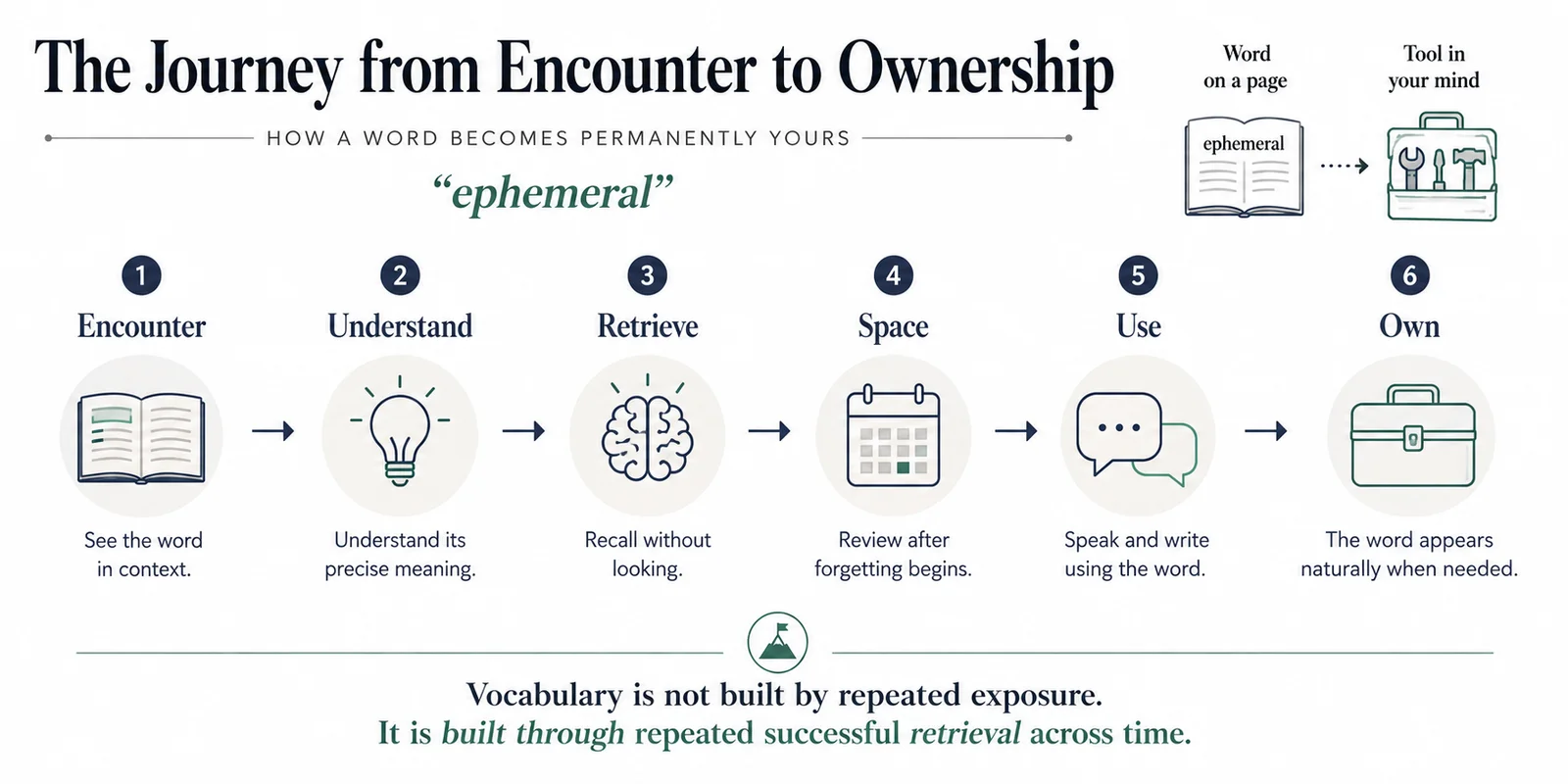
When a new word is encountered, immediately assess its utility. Avoid the trap of trying to learn every unknown word. Focus exclusively on high-leverage vocabulary that serves a specific professional, academic, or personal need. This ensures a high intrinsic Need component, satisfying the first pillar of the Involvement Load Hypothesis.
Do not settle for a surface-level, one-word synonym. Explore the precise dictionary definition, note the word's etymology, and observe its subtle connotations. Understanding exactly why a word means what it means drastically reduces the intrinsic cognitive load of memorization and builds foundational schemas.
Link the new word to preexisting knowledge. Create a bizarre, vivid mental image, or connect it to a specific personal memory. This satisfies Craik and Lockhart’s deep processing criteria and establishes a rich semantic network that facilitates elaborative retrieval later on.
Immediately close the book, minimize the browser, or turn over the flashcard and attempt to generate the word and its exact meaning entirely from memory. This initial, effortful retrieval halts the forgetting curve. It begins the neurological process of converting the temporary memory into long-term storage via the Testing Effect.
Schedule future retrieval attempts at increasingly longer intervals (1 day, 3 days, 1 week, 1 month). Utilize a digital spaced repetition system (SRS) or a physical flashcard box (like the Leitner system) to automate this scheduling. Crucially, allow enough time to pass between reviews so that the retrieval feels slightly difficult, maximizing the desirable difficulty.
To satisfy Transfer-Appropriate Processing, the word must be actively produced, not just recognized. Draft three original sentences using the word. Ensure they relate to real-life scenarios, actual work environments, or genuine personal opinions. This demands high Evaluation load, cementing the word's contextual boundaries.
Seek out the word in different environments. Reading widely ensures the word is encountered across various syntactic structures and tones. This builds a robust, context-independent schema in the brain.
Explain the word and its precise nuances to someone else, or simply dictate it aloud in an empty room. The physical motor process of articulation and the cognitive process of explaining force the brain to organize the information coherently. This bridges the final gap between passive knowledge and active, spoken fluency.
Deploy the word in a low-stakes email, a casual conversation, or a personal journal entry. The ultimate goal of vocabulary acquisition is seamless, automatic retrieval during natural communication.
Key Takeaways
- Recognition is not Mastery: Recognizing a word on a page utilizes entirely different neural pathways than retrieving a word during fluid speech. Mistaking visual familiarity for deep learning is the primary reason vocabulary is forgotten.
- Forgetting is a Feature: Memories must become temporarily inaccessible (low retrieval strength) so that the subsequent effort to recall them can build permanent durability (high storage strength).
- Passive Review Fails: Rereading notes and highlighting definitions create a dangerous illusion of competence. They require almost zero cognitive effort, leading to rapid memory decay.
- Active Recall is Non-Negotiable: Forcing the brain to search for a word without external visual clues is the single most effective way to alter a memory trace and ensure long-term retention.
- Context Matters: Because of Transfer-Appropriate Processing, a word practiced only through silent visual flashcards will rarely transfer to fluid, spoken articulation.
- Embrace Confident Mistakes: The hypercorrection effect proves that guessing a word incorrectly with high confidence, and then receiving immediate feedback, creates a psychological surprise that deeply encodes the correct information.
Conclusion: The Articulation Mandate
The pursuit of a powerful vocabulary is not a matter of aimlessly reading the dictionary or possessing a naturally superior memory. It is entirely a matter of aligning daily study habits with the biological realities of the human brain.
For decades, intelligent learners have been trapped in an endless cycle of passive consumption, hoping that sheer exposure to sophisticated language will somehow magically result in eloquence. But vocabulary is not built by mere exposure. It is built by successful retrieval, systematically repeated over time, and actively applied across shifting contexts.
People do not become articulate simply because they have been exposed to more words. They become articulate because they have intentionally forged deep, durable neural pathways that make the exact right words available precisely when they need them.
Return, for a moment, to that high-stakes interview. If that professional had abandoned the comfort of highlighting ephemeral in a coffee shop and instead actively tested their recall over three days, the outcome would be fundamentally different. The moment the thought formed, the semantic web would trigger. The neural pathway, reinforced through spaced retrieval, would fire. Without a second of hesitation, the perfect word would emerge.
By completely abandoning the comfort of passive review, embracing the desirable difficulty of active recall, and honoring the absolute necessity of context, anyone can transform their lexicon. The tools of cognitive science are readily available; the challenge is no longer knowing how memory works, but whether one is willing to do the effortful work required to truly own a word.
Leave the illusion of competence behind, and step into permanent mastery.
Frequently Asked Questions
Conversations require active retrieval under heavy cognitive and temporal pressure. If a word was only ever learned through passive recognition (reading or listening), the brain lacks the specific motor and associative neural pathways required to retrieve and articulate it dynamically. This is a classic failure of Transfer-Appropriate Processing.
Flashcards are highly effective if used correctly. They must compel active recall (producing the answer from memory before flipping the card). However, traditional flashcards often fail to provide contextual practice. To successfully bridge the gap to true fluency, flashcards should eventually prompt the learner to use the word in an original spoken sentence, not just recite a dictionary definition.
Linguistic research suggests that it often takes 10 to 15 encounters in diverse contexts for a word to be acquired incidentally. However, if deliberate active retrieval and spaced repetition are utilized, permanent retention can be achieved with a fraction of those encounters. These encounters must be strategically spaced over days and weeks to leverage the spacing effect.
Context is unequivocally superior. Isolated word lists strip away the syntactic and semantic cues that the brain relies upon to build a rich mental schema. Learning words within sentences or thematic clusters reduces extraneous cognitive load. It highlights the word's precise usage constraints and builds the elaborative networks necessary for rapid recall.
It is the false metacognitive belief that one has mastered information simply because it is currently easy to process. Rereading a highlighted dictionary definition feels highly fluent, tricking the brain into assuming the word is permanently learned and will be available tomorrow.
Spaced repetition aggressively leverages the brain's natural forgetting curve. By strategically delaying review sessions until the word is almost entirely forgotten, the brain must exert massive effort to retrieve it. This cognitive struggle signals to the neurological system that the information is vital for survival, drastically increasing its permanent storage strength.
A desirable difficulty is a carefully engineered learning condition that makes the task feel harder, slower, and more error-prone in the short term, such as testing oneself instead of rereading, but which biologically yields significantly better long-term memory retention.
No. According to the hypercorrection effect, making a high-confidence error is one of the best things a learner can do, provided they receive immediate, corrective feedback. The resulting psychological surprise acts as a powerful catalyst for permanent memory encoding.

Our English vocabulary app: FSRS spaced repetition, 5,000+ curated words across 119 topic groups, CEFR A1 to C2. Explore your mastery with the beautiful Vocabulary World feature.