What Makes Someone Articulate? The Anatomy of Clear Communication
Why some people communicate with clarity, confidence, and precision, and why it has surprisingly little to do with using big words.
- Introduction: The Room That Slips Away
- The Communication Pipeline
- The Eight Pillars of Articulation
- Why Intelligent People Sometimes Sound Inarticulate
- Why Simplicity Often Sounds Smarter
- Reading, Writing, Speaking, and Listening
- Common Habits That Hurt Articulation
- Practical Ways to Become More Articulate
- The Practical Action Plan
- Key Takeaways
- Conclusion: The Art of the Effortless Transfer
- Frequently Asked Questions
- Why a large vocabulary has almost nothing to do with being articulate
- The six-stage "communication pipeline" every spoken idea has to survive
- Why smart people often sound the most confused (it is a compression problem, not an intelligence problem)
- Concrete habits that make your speech clearer starting today
Introduction: The Room That Slips Away
Consider a familiar scene in the modern workplace. You are sitting in a conference room, and the team is grappling with a complex problem. At the end of the table sits a brilliant strategist, someone whose analytical mind is unmatched and who almost certainly holds the answer the room is searching for.
When called upon to explain their proposed solution, however, something goes awry. They start in the middle of a thought. They backtrack. They use highly technical jargon, loop their sentences around themselves, and qualify every statement with an apology or a tangent. You can feel the room slipping away. By the time they finish speaking, the collective confusion is denser than when they began.
We see variations of this everywhere. It is the brilliant student who has a profound insight but freezes during a seminar, unable to translate their understanding into a coherent argument. It is the ambitious founder whose groundbreaking vision sounds like a convoluted mess during a three-minute investor pitch. It is the dedicated language learner who knows the grammar but cannot build the bridge to a natural conversation.
The frustration in these moments is intensely physical. You feel the heat in your cheeks. You know the answer. You feel the truth of it. But the bridge between your mind and theirs is broken. The brilliance is locked inside your head, unable to survive the journey across the table.
Then, moments later, another voice chimes in. This person does not possess the same depth of technical expertise, nor do they use polysyllabic, academic terminology. Yet, they summarize the issue and the path forward in four clear, unhurried sentences. The room collectively exhales. Heads nod. The path forward is suddenly obvious.
What just happened? Why do some people consistently communicate so clearly while others struggle to express equally intelligent ideas?
The second person did not know more, nor were they inherently smarter. They simply communicated better. They possessed a trait that is highly prized yet deeply misunderstood: they were articulate.
There is a pervasive misconception that being articulate is synonymous with possessing a sprawling, intimidating vocabulary. We are taught to admire people who speak in perfectly crafted paragraphs of ornate prose, dropping words that send us quietly reaching for a dictionary. But if the goal of language is the transfer of meaning from one human mind to another, then complexity for the sake of complexity is a failure of communication.
Being articulate is not about knowing impressive words. It is the ability to transform thought into language with clarity, precision, confidence, and purpose. It is about removing the friction between what you think and what your audience understands.
Communication is judged by what arrives, not what leaves your mouth.
The Communication Pipeline
An inarticulate person views speaking as a single, spontaneous action: you open your mouth, and words fall out. An articulate person intuitively understands communication as a delicate pipeline. Every time you speak, you are pushing an idea through a sequence of filters:
Thought → Structure → Words → Delivery → Listener → Understanding
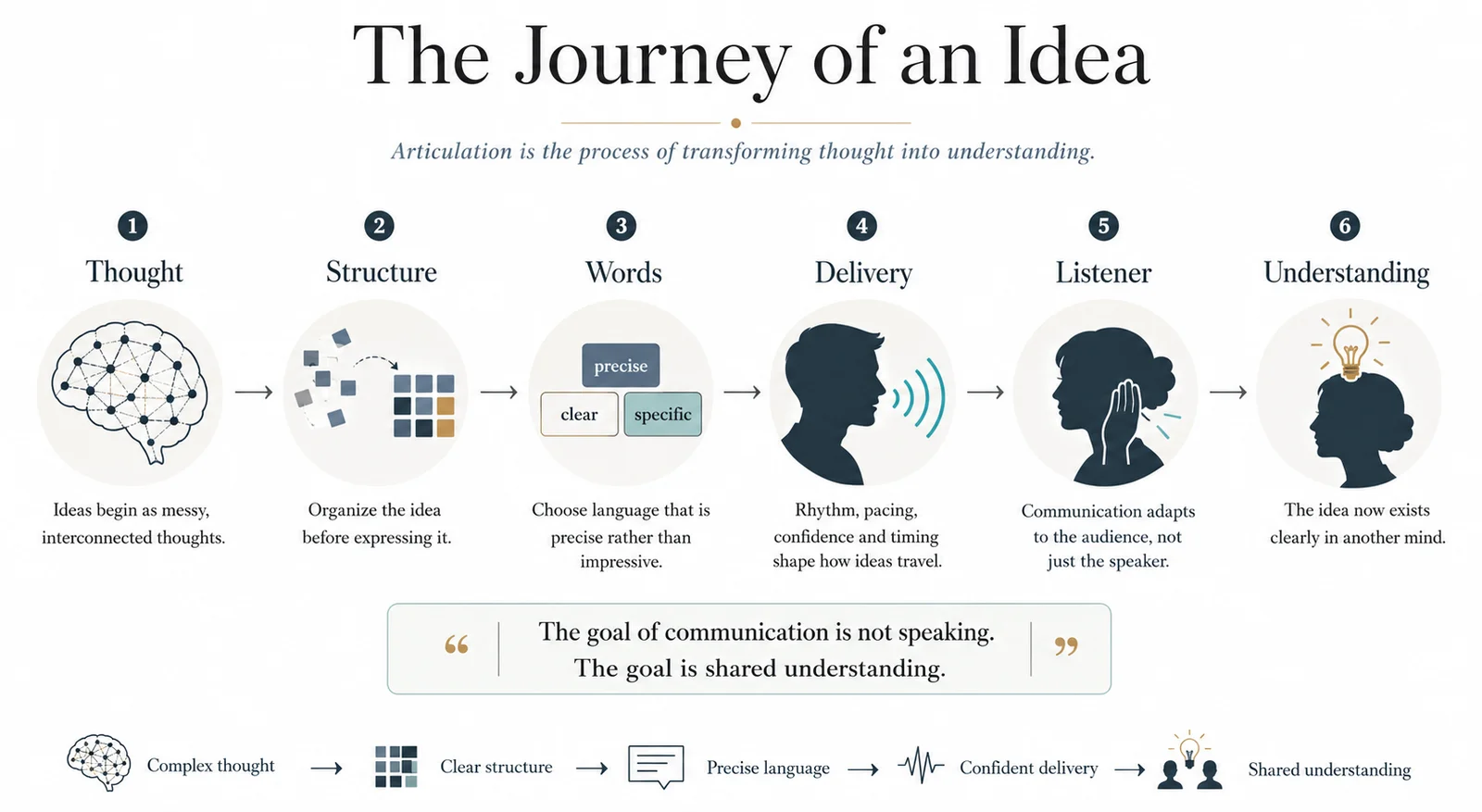
Communication succeeds or fails at every stage of this pipeline. If the thought is muddy, the structure collapses. If the words are imprecise, the delivery falters. If the listener is ignored, understanding never occurs.
To speak beautifully and effectively is not an inherited genetic trait; it is a learned discipline of keeping this pipeline clear. When we deconstruct this process into its eight fundamental pillars, we answer the central question of why some ideas land powerfully while others fade into noise.
The Eight Pillars of Articulation
Clear communication begins long before your vocal cords vibrate. It begins in the quiet machinery of your own mind. It is a fundamental truth of human interaction that confused thinking inevitably produces confused speaking. If your ideas are a tangled mess in your head, no amount of rhetorical polish will untangle them for your listener.
Thoughts do not exist in the brain as neatly typed sentences. They exist as a multi-dimensional web of concepts, memories, emotions, and abstractions. The act of speaking requires forcing this three-dimensional web through a one-dimensional funnel: a linear sequence of words.
This translation process is inherently difficult. Articulate people excel at it because they take a fraction of a second to organize their thoughts before opening their mouths. They filter out the noise. They identify the core premise. They rely on simple mental structures to guide their audience.
For instance, they might intuitively organize their thoughts as Problem → Reason → Solution ("Our timeline is slipping. We underestimated the integration phase. Let's allocate two more engineers to that task today.") Or they might use Idea → Example → Insight ("Consumers are fatigued by choice. Look at how our 20-option menu underperformed our 5-option menu. People don't want more options; they want better curation.")
Speaking is visible thinking. Steve Jobs was a master of this mental organization. He rarely used complex words, but his presentations were mesmerizing because his thinking was flawlessly structured. He never made the audience guess where he was taking them. Better thinking produces better communication.
Once a thought is clearly structured, it must be clothed in language. If there is a secret weapon in the articulate person's arsenal, it is precision. Precision is the understanding that choosing the right word matters infinitely more than choosing an impressive word.
Precision removes misunderstanding. Consider how often we rely on the word "good." We say an employee did a good job, a meeting was good, or a strategy seems good. But "good" is a blunt instrument. Did the employee do a thorough job? Was the meeting productive? Is the strategy sustainable? By swapping a generic term for a precise one, you instantly elevate the clarity of your message.
When Abraham Lincoln delivered the Gettysburg Address, he did not rely on dense academic theory to explain the Civil War. He used precise, visceral language, "conceived in liberty," "a new birth of freedom," to capture the exact emotional and historical weight of the moment. Articulate people treat words like scalpels, not broadswords. They know that precision is far more persuasive than complexity.
While vocabulary is not the totality of being articulate, it is a crucial pillar of precision. However, its value lies in utility, not vanity.
Think of your vocabulary as a painter's palette. A painter with only three colors can still create art, but a painter with sixty colors can capture the exact hue of a sunset. A broad vocabulary gives you lexical flexibility. It allows you to adjust your tone, match your audience, and capture subtle nuances.
It is vital to distinguish between your active and passive vocabulary. Your passive vocabulary contains the words you understand when you read or hear them. Your active vocabulary contains the words you can summon effortlessly in real-time conversation. The goal of an articulate person is not merely to learn obscure words, but to move highly descriptive words from their passive reservoir into their active command.
Vocabulary gives you options. Judgment chooses among them. Maya Angelou understood this intimately, often noting that words are "things" with real, physical impact. There is a distinct difference between calling a colleague "persistent" versus calling them "stubborn." Both describe someone who refuses to give up, but one opens a door and the other closes it.
Human beings are musical creatures. Our brains are wired to respond to rhythm, cadence, and pacing. If you want to know why some highly intelligent people are incredibly boring to listen to, look at the architecture of their sentences.
If every sentence is the exact same length, delivered in the exact same monotone cadence, the listener's brain will naturally tune out. It does not matter how fascinating the subject matter might be.
Articulate speakers intuitively understand the music of language. They vary the length of their sentences. They will deliver a long, flowing explanation that builds context, layers nuance, and guides the listener carefully through a complex idea.
Then, they will stop.
They will drop a short, punchy sentence.
Just like this.
This variation creates emphasis. It wakes the listener up. By manipulating pacing (speeding up to show excitement or slowing down to convey gravity), you guide your audience's emotional journey.
Clarity is the ultimate act of empathy for the listener. It is the conscious decision to prioritize the audience's understanding over the speaker's ego.
Many people mistakenly believe that stripping away complexity is a sign of intellectual weakness. In reality, distilling a complex idea into a simple, clear explanation requires a profound mastery of the subject matter. Great communicators remove friction between minds.
To speak with clarity, you must aggressively manage the cognitive load you are placing on your audience. If you use heavy jargon, convoluted acronyms, and layered abstractions, you force the listener's brain to work overtime just to decode your words. By the time they translate your jargon, they have missed your next sentence.
Consider the physicist Richard Feynman, famously known as "The Great Explainer." Feynman possessed one of the most brilliant minds of the 20th century, yet he could explain the complexities of quantum electrodynamics using relatable, everyday analogies. He firmly believed that if you could not explain an idea in simple, unadorned language, you did not truly understand it yourself.
Articulate communicators build clarity by placing the concrete before the abstract. They anchor new concepts in familiar territory, ensuring the essence of the idea remains intact while the barrier to entry is entirely removed.
It is deeply ironic that one of the most critical components of being a great speaker is the ability to close your mouth. Articulate people are almost universally exceptional listeners.
Communication is not a performance. It is a collaboration.
If you are not listening intently, you cannot adapt your language to the room. Poor communicators spend the time while others are talking mentally rehearsing what they are going to say next. Because they are not truly present, their responses often feel disjointed, selfish, or slightly off-topic.
In contrast, the articulate speaker uses listening as the ultimate calibration mechanism for their pipeline. They read the room. They notice the slight narrowing of a client's eyes that indicates confusion, and they seamlessly pivot, adjusting their vocabulary and re-explaining the concept from a different angle. They ask clarifying questions not to challenge, but to understand: "Just to make sure I'm following, are you saying the primary bottleneck is the budget, or the timeline?"
By treating the conversation as a shared building project rather than a solo performance, they elevate the entire quality of the dialogue.
The space between the words is just as important as the words themselves. Timing is the invisible force that governs how a message is received.
Many people view silence in a conversation as a void that must be frantically filled with filler words: um, like, you know. The articulate speaker views silence as a canvas. A well-placed pause before delivering a key point builds anticipation. A pause after delivering a vital piece of information gives the audience time to digest it.
Timing also involves the self-awareness to know when not to speak. In meetings and negotiations, over-explaining dilutes a strong point. Once you have made your argument clearly and effectively, stop talking.
Let the words hang in the air.
This restraint demonstrates immense control and ensures that your actual message is not buried under a landslide of nervous afterthoughts.
Confidence is the grease that allows the gears of communication to turn smoothly. It is important to discuss confidence not as a vague motivational concept, but as a neurological reality.
When you lack confidence (when you feel anxious, judged, or out of your depth), your brain releases stress hormones. This triggers a fight-or-flight response, which physically impairs your brain's ability to access the prefrontal cortex, where logic, language, and vocabulary reside.
This is why you can completely lose a word during a high-stakes interview, only for it to magically reappear in your mind the moment you step into the elevator. The knowledge was always there; your anxiety simply blocked the retrieval mechanism.
Confidence improves access to what you already know. True confidence in communication does not mean believing you are the smartest person in the room. It means being comfortable with your right to speak, trusting your preparation, and accepting that occasional stumbles are simply a natural part of human dialogue.
Why Intelligent People Sometimes Sound Inarticulate
If articulation were merely a byproduct of raw intelligence, the smartest people would automatically be the best speakers. We know from experience that this is rarely the case.
Why does a brilliant mind so often produce a scattered explanation? To understand this, we must recognize a hidden truth about language:
Communication is compression.
Our minds contain oceans of context, memories, emotions, and expertise. Speaking is the act of compressing that entire ocean into a few drops of language. A rambling speaker is handing their listener the raw, unedited file of their thoughts. An articulate speaker is handing them the compressed version.
The "curse of knowledge" is ultimately a failure of compression. When you are deeply entrenched in a complex subject, you forget what it is like not to know it. An expert's brain holds thousands of interconnected details regarding their field. When asked a seemingly simple question, their mind tries to process all of this nuance simultaneously.
They struggle to edit themselves in real time. The result is a dense monologue that attempts to cover every conceivable angle. They give the listener the entire encyclopedia when the listener just asked for a summary.
Perfectionism also sabotages the pipeline. Highly intelligent people are acutely aware of the limitations of language. They know that no single word perfectly encapsulates a complex truth, so they hesitate. They start and stop, searching for the absolute perfect phrasing, terrified of making an imprecise statement.
In their quest to be factually unassailable, they sacrifice accessibility. The paradox is that by trying to sound as intelligent as they actually are, they end up sounding insecure. Overcoming this requires a vital shift in mindset: great communicators are not the people who know the most. They are the people who know what to leave out.
Why Simplicity Often Sounds Smarter
There is a lingering societal belief that complexity equals intelligence. We see this in the corporate world, where memos are stuffed with impenetrable corporate speak, and in academia, where ideas are buried under passive-voice prose. People use big words to build a shield, hoping complexity will mask a lack of true substance.
But think of David Attenborough. He can explain the impossibly complex biological ecosystems of the deep ocean or the rainforest without ever making the viewer feel inadequate. He does not use dense scientific jargon to prove his expertise. He uses simple, majestic language that invites the viewer into the wonder of the natural world.
Simplicity is not the absence of depth; it is the mastery of it.
Stripping an idea down to its barest, most potent essence requires you to discard the fluff. It requires you to make definitive choices about what matters most.
When you use simple language to explain a difficult concept, you do not sound less intelligent. You sound like an authority. You project a quiet, unshakeable confidence. You signal to the audience that you have done the heavy lifting of comprehension so they do not have to.
Reading, Writing, Speaking, and Listening
Articulation is not developed in a vacuum. It is the culmination of habits built across the four domains of language. These are not isolated skills; they are a deeply interconnected ecosystem.
Reading expands your exposure. It is the intake valve for new ideas, new sentence structures, and new vocabulary. When you read widely, you absorb the rhythm of well-crafted prose. Reading provides the raw material from which articulate speech is built.
Writing sharpens your thinking. If speaking is visible thinking, writing is thinking made physical. Writing forces you to slow down. It demands that you organize your ideas linearly, confront logical gaps, and ruthlessly edit your own redundancies. A person who writes regularly trains their brain to structure information clearly.
Speaking develops your retrieval. You cannot become articulate purely through solitary study. Speaking requires real-time mental agility. It forces you to retrieve the words you learned from reading and the structures you built through writing, and deploy them under pressure.
Listening develops your judgment. Listening allows you to calibrate. By observing how great communicators pace their stories, frame their arguments, and use silence, you gather a mental library of techniques.
None of these domains is sufficient on its own. A person who reads constantly but never speaks may have a massive vocabulary but lack the confidence to use it. A person who speaks constantly but never writes may be charismatic but lack deep, structured substance.
Common Habits That Hurt Articulation
Before you can build the architecture of articulate speech, you must demolish the habits that stand in the way. Most of these are unconscious coping mechanisms developed to deal with nervousness.
- Filler Words: Words like um, uh, like, and you know are acoustic placeholders. We use them because our mouths are moving faster than our brains, and we are terrified of dead air. The antidote to a filler word is not a different word. It is silence.
- Vague Language and Hedges: Articulate people speak with conviction. Inarticulate speech is heavily padded with qualifiers: kind of, sort of, I think maybe, potentially. While there is a time and place for nuance, constantly hedging your statements makes you sound unsure of your own ideas.
- Rambling and Over-explaining: This stems from a fear that the listener did not understand your point the first time. Instead of making a clear statement and stopping, the speaker rephrases the same point three different ways, circling the runway but never landing the plane.
- Speaking Too Quickly: Rushing is a physical manifestation of anxiety. It suggests an underlying belief that you are taking up too much time and need to hurry before you are interrupted. Speaking too quickly ruins your sentence rhythm and gives you zero time to choose precise vocabulary.
- Trying to Sound Intelligent: When someone actively tries to sound smart, they abandon their natural voice. They reach for words they don't fully understand and prioritize their ego over the audience's comprehension. The result is almost always contrived.
Practical Ways to Become More Articulate
Becoming articulate is not a quick fix. You cannot hack your way to effortless eloquence overnight. It requires the slow, steady accumulation of habits that compound over time.
Train yourself to become comfortable with silence. When asked a question in a meeting, do not answer immediately. Take a breath. Pause for two seconds. That brief silence gives your brain the necessary runway to formulate a structured response (Problem, Reason, Solution), effectively eliminating the need for filler words.
You do not need to publish essays, but you should cultivate a private writing habit. Outlining your thoughts before a pitch or meticulously drafting emails are profound exercises in clarity. When you force yourself to articulate a problem on paper, you untangle the knots in your thinking.
Do not memorize the dictionary. Focus on utility. When you encounter a word that perfectly captures a concept you frequently discuss, write it down. Challenge yourself to use it in a conversation that week. Move it from the passive part of your brain to the active tip of your tongue.
Record yourself during a mock interview or a presentation. Listen back purely to analyze your delivery. You will instantly notice your pacing issues and reliance on filler words. Awareness is the prerequisite for behavioral change.
Most people speak faster than they realize. By consciously dialing back your speaking speed by just ten percent, you gain an immense tactical advantage. You buy yourself micro-seconds to choose better words. A slightly slower pace commands gravity and respect; it signals that your words are worth waiting for.
The Practical Action Plan
If you want to start improving your articulation today, follow this immediate action plan:
- The 2-Second Rule: For the next 48 hours, mandate a two-second pause before answering any question directed at you. Feel the discomfort of the silence, and use it to structure your first sentence.
- Audit Your Fillers: Choose one conversation today to actively monitor your use of um, like, or you know. Keep a mental tally. Awareness will naturally reduce the frequency.
- The Idea/Example/Insight Exercise: Take a complex project you are currently working on. Write down an explanation of it using exactly three sentences: one for the core idea, one for a concrete example, and one for the resulting insight.
- Draft, Don't Speak: Before your next high-stakes meeting, physically write down the three core points you want to make. Do not write a script, just bullet points. Use them as mental anchors to prevent rambling.
Key Takeaways
- Communication is a Pipeline: Articulation requires mastering the sequence of Thought, Structure, Words, Delivery, Listener, and Understanding.
- Speaking is Visible Thinking: Confused thoughts lead to confused speech. Organizing your ideas into simple mental structures before opening your mouth is the foundation of clear communication.
- Communication is Compression: Stripping away complexity and jargon to explain ideas simply is a hallmark of true intelligence and empathy for the listener.
- Communication is Collaboration: The most articulate people are exceptional listeners. They read the room, adjust their vocabulary, and prioritize the audience's comprehension over their own performance.
- Rhythm and Timing Matter: Varying sentence length, utilizing strategic pauses, and slowing down your cadence keeps listeners engaged and prevents you from rushing under pressure.
Conclusion: The Art of the Effortless Transfer
We are all trapped inside our own minds, experiencing a vivid, complex reality that is entirely our own. Language is the bridge that allows us to cross over and share that reality with someone else.
When that bridge is poorly constructed, our best ideas remain locked in the boardroom, trapped in our own heads. The brilliant strategist stays misunderstood. The visionary founder loses the room.
But when that bridge is built with precise words, structured thinking, and empathetic timing, the crossing is effortless. The listener feels the weight of your idea exactly as you intended. The friction disappears.
Articulation is not about proving how much you know. It is about proving how much you care about the person listening.
Great communicators understand that vocabulary is merely the raw material. The true art lies in the assembly. By focusing on clarity over complexity, precision over vanity, and connection over ego, you strip away the barriers between yourself and the world.
Being articulate is not the art of speaking beautifully. It is the discipline of being understood completely. It is the generous act of ensuring that your brightest, most vital ideas never have to die in the silence of your own mind.
Frequently Asked Questions
It gives you more tools, but it only makes you better if you use those tools to increase precision and clarity. If you use a large vocabulary to sound impressive, confusing your audience in the process, it actually makes you a worse communicator.
Anxiety triggers a fight-or-flight response in the brain, flooding your system with stress hormones. This physically inhibits your ability to access the prefrontal cortex, which handles language retrieval. Managing the physiological symptoms of anxiety, through pacing and breathing, helps restore this access.
Filler words happen when your mouth outpaces your brain. The most effective way to eliminate them is to become comfortable with silence. When you feel a filler word coming, simply close your mouth and pause. A one-second silence feels natural to the listener and gives your brain time to catch up.
Absolutely. Introverts often make exceptional communicators because they naturally lean toward deep thinking and active listening, two critical pillars of articulation. Articulate speaking does not require being the loudest in the room; it requires being the clearest.
Writing is asynchronous; you have unlimited time to search for words, structure your arguments, and edit your mistakes. Speaking happens in real time under social pressure. Bridging the gap requires practicing verbal retrieval, essentially speaking your structured thoughts out loud.
Passive vocabulary consists of words you recognize and understand when reading or listening. Active vocabulary consists of the words you can effortlessly recall and use in live conversation. Improving articulation often involves moving useful words from passive recognition to active use.
If you find yourself saying, "in other words," or "what I mean is" multiple times in the same explanation, you are likely over-explaining. Make your point clearly once, provide a concrete example, and then stop talking. Look at the listener's body language; if they nod, move on.
Yes. Fiction exposes you to narrative structure, varied sentence rhythms, and nuanced vocabulary in context. It also builds empathy, which translates into a better understanding of how your audience receives your messages.
Confidence in speech comes from pacing and finality. Slow down your delivery by ten percent. When you finish a sentence, drop your pitch slightly rather than ending on an upward, questioning inflection. Speak fewer words, but stand firmly behind the ones you choose.
Yes. Try “jamming.” Pick a random household object, like a coffee mug, and talk about it for 60 seconds straight without stopping, hesitating, or using filler words. It trains your brain's real-time word retrieval under artificial pressure.

Our English vocabulary app: FSRS spaced repetition, 5,000+ curated words across 119 topic groups, CEFR A1 to C2. Explore your mastery with the beautiful Vocabulary World feature.